
AZ-900 Microsoft Azure Fundamentals: What It Actually Is and Whether You Should Take It
Maybe you saw "AZ-900" in a job description and had no idea what it meant. Maybe a colleague mentioned it and you nodded along. Maybe you've been in IT for years and somehow Azure's foundational exam has never been on your radar.
Whatever brought you here — you're in the right place.
This isn't a study guide packed with domain definitions. It's the honest overview most people wish they had before they started researching what the AZ-900 actually is, who it makes sense for, what the exam looks like, what it costs, and where it fits in a longer career picture.
By the end, you'll know exactly whether AZ-900 is worth your time — and if it is, what to do next.
What AZ-900 Actually Is — No Jargon
AZ-900 is the Microsoft Azure Fundamentals certification. It's the starting point of Microsoft's entire Azure certification ladder — the credential that says "I understand how cloud computing works and how Azure fits into that picture."
It doesn't require you to already be technical. That's the part people don't expect. It was built for a wide audience — IT professionals, business analysts, project managers, finance teams, and career changers who want to understand cloud computing without needing to write code or manage servers.
More than 1.2 million professionals have earned the Azure Fundamentals credential since its launch, making AZ-900 the most widely taken cloud exam in history. That number tells you something important — this isn't a niche credential. It's become a baseline expectation across a wide range of cloud-adjacent roles.
One thing worth knowing upfront: Microsoft renamed AZ-900 as "Introduction to Cloud Infrastructure" in its marketing materials in January 2026 while keeping the AZ-900 exam code unchanged. The certification you earn is still called Microsoft Certified: Azure Fundamentals. If you see both names floating around in your research, they refer to the same thing.
Who It's Actually For — And Who Should Skip It
Most articles dance around this question. So here's the direct version.
AZ-900 makes sense if you're new to cloud computing and want a verified credential that proves foundational knowledge. It also makes sense if you work in a non-technical role — sales, project management, finance, compliance — at a company using Azure, and you're tired of nodding along when your technical colleagues talk. Same goes if you're transitioning into IT or cloud from another career and need a starting point that doesn't assume prior experience. Or if you already know some Azure basics and just want to confirm that knowledge before moving to a role-based certification like AZ-104.
It probably isn't for you if you already have hands-on Azure experience in a current job. Skip straight to AZ-104. AZ-900 will just cover material you already know, and employers hiring for cloud roles care more about the role-based credentials anyway. It also isn't for you if you're expecting a single credential to get you hired as a cloud engineer on its own. That's not how it works. AZ-900 opens doors. It doesn't close job offers by itself.
Think of it as a starting point and a signal. It tells an employer or hiring manager that you understand cloud fundamentals well enough that they don't need to explain them to you from scratch. What you do with it after that is what actually shapes your career.
What the Exam Looks Like
The AZ-900 is a focused exam. Forty-five minutes. Thirty-two to sixty questions depending on your exam form. A passing score of 700 out of 1000. Microsoft uses scaled scoring, which means 700 doesn't correspond to exactly 70% of questions answered correctly — the weighting of individual questions affects your final number. What matters is clearing 700.
The exam covers three domains, and the weighting matters more than most people realize.
Cloud Concepts sits at 25 to 30% of the exam. This is the foundational layer — what cloud computing is, why organizations use it, the different cloud models (public, private, hybrid), and the service models (IaaS, PaaS, SaaS). It seems straightforward. It isn't, quite. Microsoft's precise terminology is where candidates consistently lose points — scalability versus elasticity, high availability versus fault tolerance, CapEx versus OpEx. These distinctions matter on exam day, even though they feel like splitting hairs while you're studying.
Azure Architecture and Services is the heaviest domain at 35 to 40 percent of the exam, which means your study time should reflect that weight. It covers core Azure services — compute, storage, networking, databases, identity, security. This is also where the January 2026 additions land. Azure AI Services, Microsoft Copilot, and Responsible AI principles now appear throughout this domain, so don't skip past them assuming they're a side note.
Azure Management and Governance rounds things out at 30 to 35%. Cost management, pricing tools, governance features like Azure Policy and resource locks, monitoring tools like Azure Monitor and Azure Advisor. Most candidates underinvest study time here because it sounds dry. That's exactly why it's where points get lost.
Microsoft updated the official exam objectives on January 14, 2026, adding expanded coverage of Azure AI Services, Microsoft Copilot, and Responsible AI principles throughout all three domains. Candidates using study materials published before January 2026 are preparing for an outdated version of the exam. If you're using older resources, check the publication date before you rely on them. It's a small thing that trips up a surprising number of people.
What It Costs — The Full Number, Not Just the Headline
The AZ-900 exam costs $99 USD in the United States. Prices vary by country — India runs approximately ₹3,691 plus taxes. That's the exam voucher. One attempt.
The full investment looks like this: the $99 voucher, plus study materials if you go the paid route (though Microsoft Learn's free content is genuinely comprehensive, so you may not need to), plus optional practice exam access, which typically runs $20 to $50 depending on the platform. Add it up and self-study lands most people at $100 to $150 total.
One detail worth knowing: AZ-900 does not expire. Microsoft Fundamentals certifications are lifetime credentials — unlike role-based certifications that require annual renewal. Pass it once and you hold it permanently. No renewal fees chasing you down every year.
There's also a free voucher option. Microsoft periodically offers free AZ-900 vouchers through Virtual Training Days — free online events where completing the full session earns you a 100% discount code. It's worth checking Microsoft's events calendar before you pay full price. Why pay $99 for something you might be able to get for free?
For a detailed breakdown of what the exam actually costs beyond just the voucher — including study materials, retake fees, and what's genuinely free.
How Long You Actually Need to Study
Two to four weeks at five to eight hours per week is typical for most candidates. With prior IT experience, some pass in under a week.
If you've never worked in IT and cloud computing is genuinely new to you, give yourself four weeks and treat it seriously. Don't rush it. If you've been working in IT support or adjacent roles and just need to formalize foundational knowledge, two weeks of focused preparation is realistic.
Here's what doesn't work: treating it as a last-minute effort. AZ-900's reputation for being "easy" causes more failures than the content does. Candidates who walk in having only skimmed the material run into scenario-based questions that require actual understanding, not memorization. That gap shows up in the score, every time.
For a week-by-week study plan built specifically around a full-time job schedule.
Can You Take It Online?
Yes. AZ-900 can be taken in person at a Pearson VUE test centre or online via the OnVUE application from home. Both options are proctored and require a valid government-issued photo ID.
Online proctoring is convenient. But it comes with room setup requirements that catch people off guard more often than you'd think. A phone in view, a second monitor plugged in, someone walking through the room mid-exam — any of these can pause or void your session. These aren't rare edge cases. They happen regularly to people who didn't bother reading the requirements closely enough.
For exactly what the online exam requires and what trips people up on exam day.
Will It Actually Help Your Career?
This is what most people really want to know, so let's get into it.
AZ-900 alone typically adds $5,000 to $8,000 to an existing IT salary. The real jump comes when you pair it with AZ-104, which adds another $15,000 to $25,000 on top of that. That's the useful way to frame it: AZ-900 is the foundation, not the destination.
It gets your resume past ATS filters for cloud-adjacent roles. It gives you credible language to use in interviews instead of vague gestures at "cloud stuff." And it builds the foundation that makes every subsequent Azure certification faster to earn, because you're not starting from zero anymore. A 2026 Pearson VUE survey found 56% of IT professionals received a pay increase within three months of earning a Microsoft certification.
None of that means it'll land you a cloud engineering role by itself. It won't dramatically transform your compensation if you're already deep in IT, either. The people who get the best return treat it as step one of a deliberate path — AZ-900, then hands-on Azure experience, then AZ-104 — rather than a credential they collect and move on from.
For honest salary data and who gets the best ROI from AZ-900.
Where AZ-900 Fits in a Longer Path
AZ-900 sits at the base of Microsoft's certification structure. From here, most professionals move in one of three directions depending on their career goals.
If you're headed toward Azure administration — managing cloud infrastructure, handling access control, configuring virtual machines and networks — the next step is AZ-104 (Azure Administrator Associate). This is where the job market starts to get meaningfully competitive and where compensation increases substantially.
If security is more your speed — protecting cloud environments, managing identity, handling compliance — AZ-500 (Azure Security Engineer Associate) is the natural next credential once you've built some hands-on experience.
And if you're aiming higher, at designing cloud solutions on a systems level, AZ-305 (Azure Solutions Architect Expert) is the senior credential in that direction. It typically requires working through AZ-104 first, so don't expect to jump straight there.
If you've already passed AZ-900 and are figuring out what comes next, the [AZ-104 path](https://www.certsinfinity.com/blog/microsoft-az-104-passed-now-what-the-first-90-days-nobody-prepares-you-for) is where most people see the clearest combination of job market demand and salary impact.
One Concrete Next Step
If you've read this far, you have enough information to make a decision.
If AZ-900 makes sense for you, check Microsoft's Virtual Training Day schedule before buying a voucher. Attend a free event, earn the discount code, save the $99. Then start with Microsoft Learn's free AZ-104 learning path, which walks through all three domains in order.
If you want practice questions that reflect the current January 2026 exam objectives — including the AI and Responsible AI content that older question banks are missing — CertsInfinity's AZ-900 materials are updated to the current blueprint.
The exam is 45 minutes. The prep is two to four weeks. The credential lasts a lifetime. If cloud is where your career is heading, there's no reason to wait.
Related Articles
Microsoft AZ-104 Passed. Now What? The First 90 Days Nobody Prepares You For
You passed. You remember the exact moment — the screen went blank for a second,...
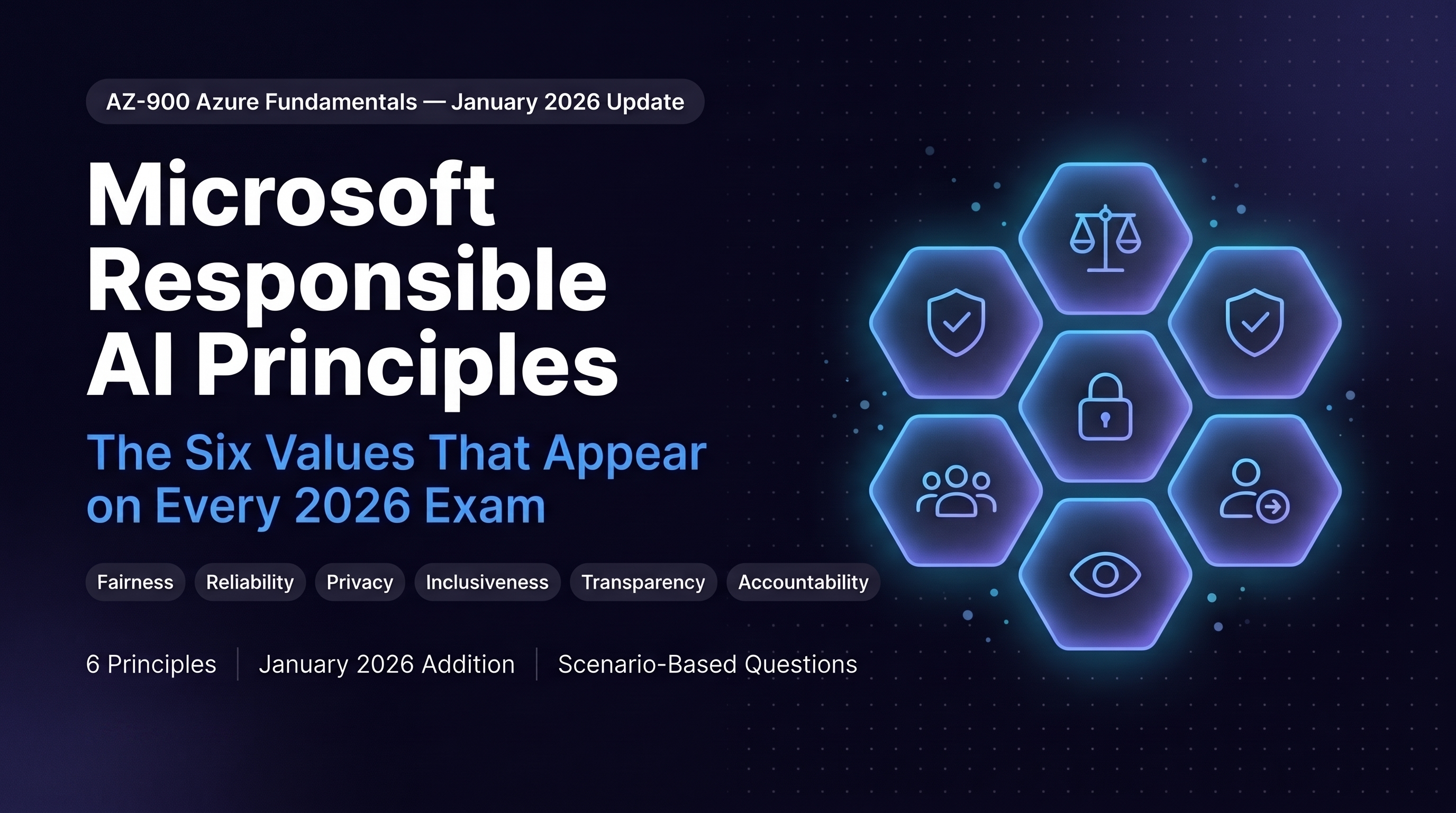
The Responsible AI Principles Question That Tricks Almost Everyone
You're three weeks into studying for AZ-900. You feel good. Cloud concepts make ...
Is AZ-900 Open Book? What You Can and Can't Bring to This Exam
You've been studying for weeks. Notes everywhere. Tabs open on your browser. A n...