
The Responsible AI Principles Question That Tricks Almost Everyone
You're three weeks into studying for AZ-900. You feel good. Cloud concepts make sense now. You know your IaaS from your PaaS. You've worked through storage redundancy acronyms until they stopped making you nervous.
Then you hit a Responsible AI question.
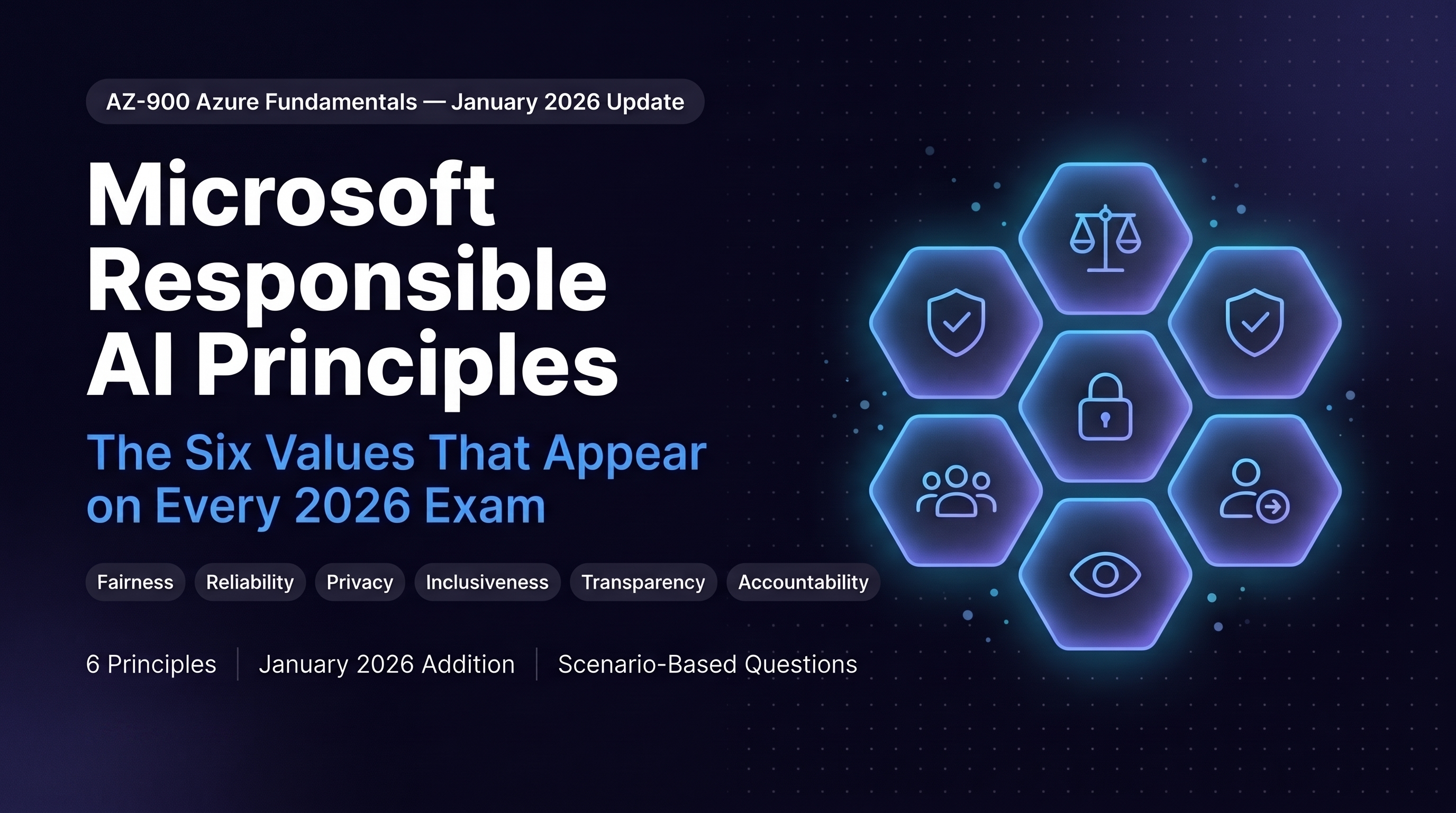
The scenario describes a company deploying a hiring algorithm. The question asks which principle was violated. And suddenly all six principles — fairness, reliability and safety, privacy and security, inclusiveness, transparency, accountability — are sitting in your head at the same time, and two of them sound like they could both be right.
That moment, right there, is where a surprising number of AZ-900 candidates lose points they should have kept.
It's not because the topic is technically hard. It's because Microsoft doesn't test whether you know what these principles are — it tests whether you can map a specific real-world scenario to the exact right one. And that's a completely different skill from reading a definition.
This article is about building that skill before exam day.
Why Responsible AI Is on AZ-900 at All
A lot of candidates treat this topic as a late add-on — something Microsoft tacked on to look current. That's the wrong way to think about it.
Microsoft added expanded AI coverage to AZ-900 in its January 14, 2026 update. Responsible AI principles, Azure AI Services, and Microsoft Copilot are now tested across all three exam domains — not just mentioned in passing. If you're using study materials published before that date, you're preparing for a different exam than the one you're going to sit.
The reason Microsoft included this content isn't arbitrary either. The isc2 cc certificate world has security ethics baked in. Microsoft's AZ-900 does the same thing for cloud and AI — it wants Azure professionals at every level to understand the ethical framework the platform is built on. That's not going away.
So yes, you need to know this. And you need to know it well enough to answer scenario questions under time pressure, not just recognize the principle names when you see them listed.
The Six Principles — What They Actually Mean
Here they are. Not as definitions to memorize, but as mental models that help you pick the right one when a scenario question is in front of you.
Fairness — the principle about who gets treated equally. If an AI system produces different outcomes for different groups of people — different loan approval rates by ethnicity, different hiring scores by gender — that's a fairness problem. The trigger word in exam questions is almost always some version of discrimination, bias, or unequal treatment based on a protected characteristic.
Reliability and Safety — the principle about whether the system works as intended, consistently, even in unusual conditions. A self-driving vehicle that fails in unexpected weather. A medical AI that produces different results for the same input depending on when it's asked. If the scenario involves the system behaving inconsistently, failing under stress, or causing unintended harm, this is your answer.
Privacy and Security — the principle about protecting personal data and keeping systems secure from unauthorized access. The trigger here is usually data — who has access to it, how it's stored, whether it can be breached. If a scenario mentions user data, personal information, or unauthorized access, this principle almost always applies.
Inclusiveness — the principle about whether the system works for everyone, including people with disabilities, different languages, or different levels of technical ability. This one is specifically about access and participation — whether all people can benefit from and engage with the AI system. An accessibility gap is an inclusiveness problem. Being designed for only one demographic is an inclusiveness problem.
Transparency — the principle about whether people understand what the AI is doing and why. Two versions of this show up on the exam. First: does the user know they're interacting with an AI at all? Second: can the AI's decisions be explained in a way that makes sense? A chatbot that pretends to be human violates transparency. An AI that approves or rejects applications without being able to explain why also violates transparency.
Accountability — the principle about human oversight and responsibility. This one is about whether people are responsible for what the AI does. If an AI system operates with no human review, no audit process, no governance structure — that's an accountability gap. The trigger words are governance, oversight, human review, and responsibility.
Where the Exam Gets Tricky
Here's the thing: Microsoft knows these principles overlap. That's intentional. A hiring algorithm that discriminates against women could violate fairness. If the company didn't disclose how the algorithm makes decisions, it also violates transparency. If there's no human review process for appeals, accountability is also in play.
So why does the exam have one right answer?
Because the question is always anchored to a specific aspect of the scenario. The key is learning to identify what the scenario is actually describing — the primary violation — rather than which principles are technically relevant.
Let's work through a few examples in the style you'll actually encounter.
Example 1:
A financial services company uses an AI system to approve or reject loan applications. An internal audit reveals that applications from applicants in certain postcodes are rejected at significantly higher rates, even when the financial profiles are nearly identical to approved applicants from other areas.
Which Responsible AI principle is most directly violated?
A) Accountability
B) Transparency
C) Fairness
D) Privacy and Security
The answer is C — Fairness. The scenario describes differential outcomes for a group based on a characteristic (location used as a proxy for other demographics) rather than on the relevant financial factors. There's no mention of missing human oversight (accountability), unexplained decisions (transparency), or data breaches (privacy). The primary issue is unequal treatment.
Example 2:
A company deploys an AI customer service chatbot that handles billing queries. Customers routinely complain that they don't realize they're speaking to an automated system until they try to escalate a complaint and the chatbot cannot help them.
Which Responsible AI principle is most directly violated?
A) Inclusiveness
B) Transparency
C) Reliability and Safety
D) Fairness
The answer is B — Transparency. The customers don't know they're interacting with AI, which means the system isn't being clear about what it is and how it works. Nothing in the scenario suggests the chatbot is producing inconsistent results (reliability), treating groups differently (fairness), or excluding people from access (inclusiveness).
The pattern you should notice: once you've identified the primary wrong thing the scenario describes, the right principle becomes obvious. The difficulty is in resisting the instinct to pick the principle whose name sounds most related to the topic, and instead picking the one that matches what's actually happening.
The Confusing Pairs — And How to Separate Them
Three pairs cause the most confusion on exam day. Here's how to tell them apart cleanly.
Fairness vs Inclusiveness. Fairness is about equal treatment — not discriminating against protected groups. Inclusiveness is about access — making sure all people can participate and benefit. A job posting AI that scores women lower than equally qualified men is a fairness issue. A job posting AI that only works in English, excluding non-English speakers, is an inclusiveness issue. Different problems, different principles.
Transparency vs Accountability. Transparency is about whether decisions can be understood and explained. Accountability is about whether humans are responsible for those decisions. If an AI makes decisions that can't be explained, that's transparency. If an AI makes decisions and nobody is responsible for reviewing or overriding them, that's accountability. The useful question: is the problem that we don't understand the AI, or that nobody is in charge of it?
Reliability and Safety vs Privacy and Security. Both involve protecting people from harm, but in completely different ways. Reliability is about the system working as intended and not causing unintended harm through malfunction. Security is about protecting data from unauthorized access or breach. A self-driving car that crashes in unexpected weather — reliability. A healthcare AI that shares patient data without authorization — privacy and security.
What This Means for Your Study Plan
If you're preparing for AZ-900 in 2026, Responsible AI questions are guaranteed. They're woven across all three domains now, not isolated to a single section. And they're scenario-based, which means they can't be answered by recognizing a principle name — they require you to apply a principle to a situation you haven't seen before.
The most efficient way to prepare is exactly what this article has modeled: work through scenarios, identify the primary wrong thing being described, and practice eliminating the plausible-but-wrong options. That kind of active practice with real az-900 practice test questions is what closes the gap between knowing the principles and being able to apply them under exam conditions.
Platforms like CertsInfinity keep their AZ-900 question sets updated to reflect current exam objectives including the January 2026 additions — worth using specifically for Responsible AI scenario practice, since pre-2026 question banks simply won't have this content.
One last thing: Microsoft's official Responsible AI documentation is publicly available and worth reading once through — not to memorize it, but to see how Microsoft itself describes each principle. The language in that documentation often shows up almost verbatim in exam questions, and reading it in context makes the distinctions between principles significantly easier to remember.
Questions People Actually Ask About This Topic
What are Microsoft's core Responsible AI principles?
There are six: Fairness, Reliability and Safety, Privacy and Security, Inclusiveness, Transparency, and Accountability. For AZ-900 purposes, the key skill isn't naming them — it's mapping each one to the right type of scenario.
What are the six pillars of Responsible AI?
Same as above. "Pillars" and "principles" refer to the same framework. Some study materials use both terms interchangeably — they mean the same thing in the Microsoft context.
How do I know if my AI system is trustworthy?
Microsoft's framework suggests looking at all six principles together: Does it treat people equally? Does it work consistently? Does it protect data? Does it work for everyone? Are its decisions explainable? Is there human oversight? A trustworthy system holds up across all six — a gap in any one is a risk.
What does Responsible AI actually mean for a business?
In practical terms, it means building AI systems that won't surprise you in bad ways — systems that don't discriminate, don't fail unpredictably, don't expose data, work for all users, can be explained, and have humans accountable for their behavior. For the AZ-900 exam specifically, it means understanding which of these concerns a given scenario is describing.
How does Microsoft ensure AI accountability?
Microsoft's approach emphasizes human-in-the-loop design — building AI systems with human review processes, audit trails, and governance structures rather than fully autonomous decision-making. In exam terms, accountability violations show up when AI systems operate without any oversight mechanism.
What's the difference between AI transparency and AI explainability?
In Microsoft's framework, transparency is broader — it includes both disclosing that a system is AI and being able to explain how it makes decisions. Explainability is a component of transparency rather than a separate principle. On the AZ-900, if a scenario involves either users not knowing they're interacting with AI or being unable to understand why a decision was made, transparency is your answer.
Can AI be both powerful and responsible?
Microsoft's position is yes — and the AZ-900 exam reflects that framing. Responsible AI isn't about limiting what AI can do; it's about ensuring what it does is fair, safe, and trustworthy. For the exam, you won't be asked to evaluate trade-offs between capability and ethics. You'll just be asked to recognize which principle applies to a given situation.
What responsible AI features does Microsoft Copilot have?
Copilot is built with Microsoft's Responsible AI framework applied throughout — content filters for safety, transparency about what it can and can't do, data privacy controls, and logging for accountability. On the AZ-900, Copilot appears as an example of an AI system that implements these principles, not as a deep technical topic.
One Thing You Can Do Before You Close This Tab
Go find a Responsible AI practice question — any one will do — and instead of just picking an answer, write out in one sentence what the primary wrong thing in the scenario is. Then check whether your answer matches the principle that covers that specific wrong thing.
Do that ten times and you'll find the exam questions stop being confusing. The principles stop being a list to memorize and start being a set of categories you can sort scenarios into automatically.
That's the shift that actually changes your score.
Related Articles
Microsoft AZ-104 Passed. Now What? The First 90 Days Nobody Prepares You For
You passed. You remember the exact moment — the screen went blank for a second,...
AZ-900 Microsoft Azure Fundamentals: What It Actually Is and Whether You Should Take It
Maybe you saw "AZ-900" in a job description and had no idea what it meant. Maybe...
Is AZ-900 Open Book? What You Can and Can't Bring to This Exam
You've been studying for weeks. Notes everywhere. Tabs open on your browser. A n...