
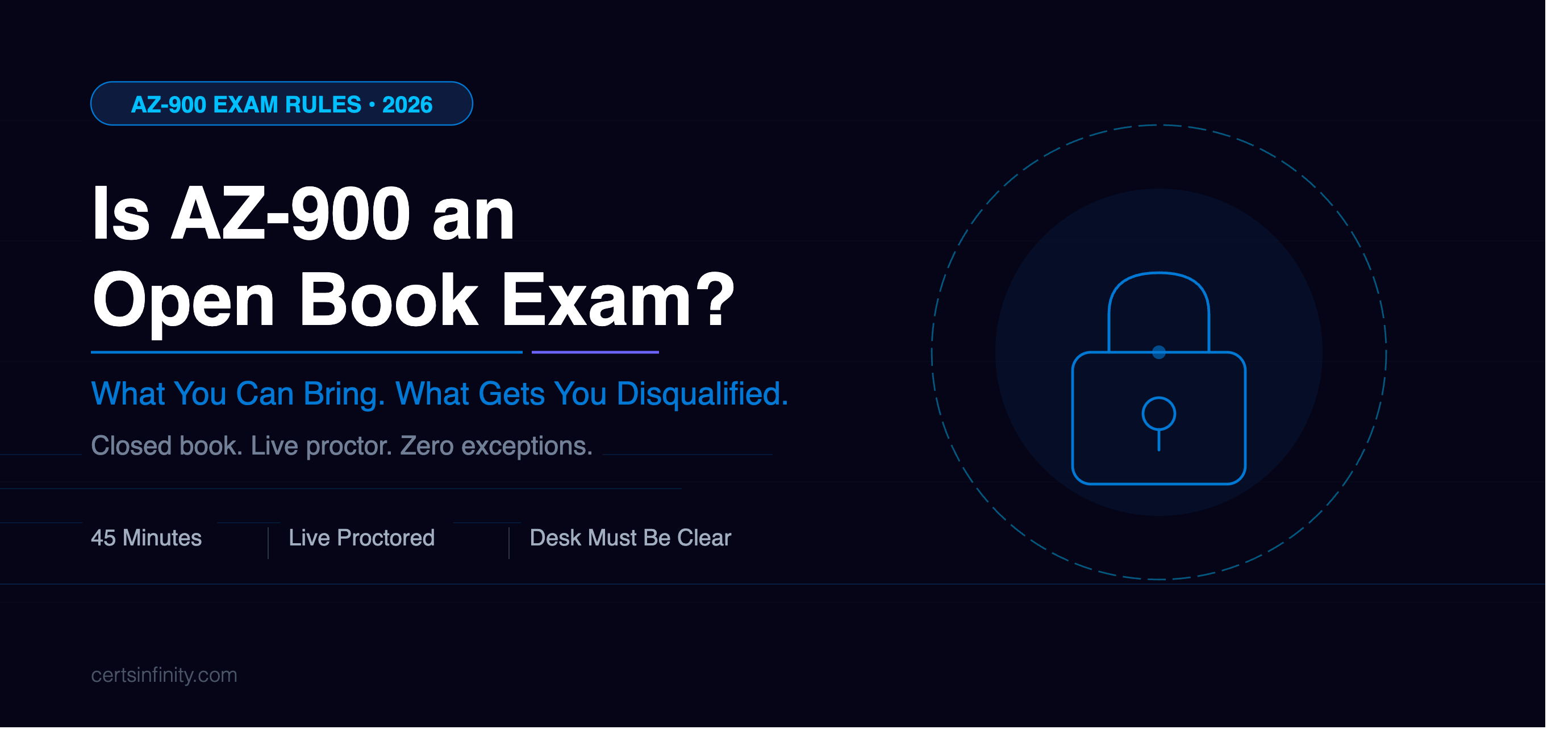
Is AZ-900 Open Book? What You Can and Can't Bring to This Exam
You've been studying for weeks. Notes everywhere. Tabs open on your browser. A notebook full of abbreviations that made sense when you wrote them. And then, somewhere in the back of your mind, a question quietly surfaces.
Wait — can I just... bring my notes in?
It's a reasonable thing to wonder. Some professional exams allow reference materials. Some online certifications are entirely open book. And if you're new to Microsoft's certification ecosystem, there's no obvious reason to assume AZ-900 works the same way as every other exam you've ever taken.
So let's answer this cleanly, before you find out the hard way on exam day.
No. AZ-900 Is Not an Open Book Exam.
Not at a test centre. Not online from home. Not in any format, under any circumstances.
Your desk must be completely clear — no notes, no phone, no second monitor, no drinks unless explicitly allowed. That applies whether you're sitting in a Pearson VUE test centre or taking the exam through OnVUE online proctoring from your own room. The rules are the same. The consequences for breaking them are the same.
microsoft
This isn't a technicality buried in the fine print. It's enforced actively. A proctor verifies your identity, asks you to scan your testing environment using your webcam, and confirms that your workspace meets the requirements before the exam begins. If your notes are visible, your exam doesn't start. If they become visible during the exam, it can be paused or voided entirely.
Microsoft Learn
What You're Not Allowed to Have
The list is specific, and it's worth knowing before exam day rather than during check-in.
No notes of any kind — printed, handwritten, on sticky notes, or on a whiteboard in the background. No phone within reach or visible in the camera frame. No second monitor plugged in — even if it's turned off, its presence can trigger a warning. No headphones or earbuds. No smartwatch. No external keyboard if you're using a laptop. No one else in the room with you during an online proctored session.
The online proctoring system involves a check-in process that typically begins 30 minutes before your scheduled exam start time. During that process, you'll perform a 360-degree room scan, show your desk surface from multiple angles, and show your ID to the camera. If anything in that scan violates the rules, you won't be allowed to proceed until the issue is resolved — and if you can't resolve it quickly, you may lose your exam slot.
ISC2
Microsoft Learn
At a physical test centre, the rules are enforced by staff on-site. You'll check in at reception, leave your belongings in a locker, and enter the testing room with nothing but what the centre provides — which is typically a laminated scratch sheet and a marker that gets wiped clean after your session.
What You Are Allowed to Have
Almost nothing — and that's the point.
At a test centre, you'll be given a laminated sheet and a dry-erase marker for notes during the exam. Some centres use paper with a pen. You can use this during the exam itself. You cannot take it out of the room when you're done.
For online proctored exams, you can have water in a clear container. That's about it. No food. No snacks. Nothing that requires you to look away from the screen for an extended period.
microsoft
If you need to write something down during the exam — a formula, a relationship between concepts, something you want to come back to — the scratch material provided at test centres is there for that. Online candidates can use a physical whiteboard visible to the camera, or in some cases a blank piece of paper, but this varies by proctor and you should verify it before your session.
Why the Exam Is Closed Book — And Why That's Actually Fine
This is the part that causes the most anxiety, but it shouldn't.
AZ-900 doesn't test whether you can look things up. It tests whether you understand how Azure works at a conceptual level. Around 30 to 40 percent of questions are scenario-framed — a company needs X, which service should they choose — and rote memorization of definitions doesn't answer these. You need to understand why Azure Policy enforces compliance differently from RBAC. You need to know when you'd use a VPN Gateway versus ExpressRoute, and what the difference actually means in a business context.
microsoft
That kind of understanding doesn't come from notes. It comes from actually learning the material to the point where you can reason through an unfamiliar scenario. Which, conveniently, is exactly what proper exam preparation builds.
The exam is 45 minutes. Thirty-two to sixty questions. You need 700 out of 1000 to pass. Microsoft uses scaled scoring, so 700 doesn't correspond to exactly 70 percent of questions correct. What matters is clearing that threshold — and with proper preparation, the closed-book format isn't the obstacle most people fear it will be.
How to Prepare So You Don't Need Notes
The irony of closed-book exams is that the best preparation makes the closed-book format irrelevant. If you know the material well enough, you don't need notes. If you're relying on notes, you haven't learned the material well enough yet.
A few things that actually work for AZ-900 specifically. Study one domain at a time rather than trying to absorb everything at once. After each domain, do 30 to 50 practice questions on just that domain — not to memorize answers, but to find the concepts you thought you understood but actually didn't. Read every explanation for every question you get wrong until you can explain, in your own words, why the correct answer is correct and why each wrong answer is wrong.
Score consistently above 75 percent on full-length timed practice exams before you book your date. That buffer gives you room to handle the harder scenario questions without running out of time or confidence.
microsoft
Microsoft Learn's official study content is free and aligned to the current January 2026 exam objectives — including the Azure AI Services, Microsoft Copilot, and Responsible AI Principles content that was added in the latest update. Start there before spending money on anything else. For broader practice question exposure, platforms like CertsInfinity keep their AZ-900 question banks updated to the current blueprint, which matters specifically for the new AI content that older question banks are missing.
Frequently Asked Questions
Will AZ-900 help me get a job?
It opens doors rather than closing job offers on its own. For non-technical roles at cloud companies, it signals cloud literacy and gets your resume past initial screening. For IT professionals, it validates foundational knowledge formally before moving to AZ-104. The career value compounds when you treat it as step one rather than the destination.
Can I pass AZ-900 with no IT experience?
Yes — it's specifically designed for people without prior IT experience. The exam tests conceptual understanding, not hands-on technical skill. Four weeks of focused study at five to eight hours per week is realistic for someone starting from zero.
How many questions are on AZ-900?
Between 32 and 60 questions depending on your exam form. The exam duration is 45 minutes, and you need 700 out of 1000 to pass using Microsoft's scaled scoring system.
Can I retake AZ-900 if I fail?
Yes. Microsoft allows retakes. If you fail on the first attempt, you can retake without a waiting period. After a second failure, a 14-day wait applies before each subsequent attempt. You pay the exam fee each time — currently $165 USD — so it's worth getting properly prepared before your first attempt rather than banking on retakes.
Is AZ-900 still offered in 2026?
Yes, and it was updated in January 2026 with new content covering Azure AI Services, Microsoft Copilot, and Responsible AI Principles. The exam is actively administered and remains the most widely taken cloud certification in the world with over 1.2 million holders.
How often can I take the AZ-900 exam?
As often as you need to, with the waiting period rules above applying after failures. There's no annual cap on attempts. Microsoft does monitor for unusual exam activity, so the expectation is genuine preparation between attempts rather than repeated attempts without study.
Can I take AZ-900 practice tests before the real exam?
Yes, and you should. Microsoft offers an official practice assessment through Microsoft Learn at no cost. Third-party platforms provide additional question sets that expose you to more varied scenarios. Book your exam only after scoring 85 percent or higher consistently across two different practice providers.
microsoft
What score do I need to pass AZ-900?
700 out of 1000 on Microsoft's scaled scoring system. This doesn't mean 70 percent of questions correct — individual questions carry different weights, and the final score reflects that weighting. Your score report after the exam breaks down performance by domain, which is useful if you need to retake.
One Thing Worth Doing Before Exam Day
If you're taking the online proctored version, run the Pearson VUE system check at least two to three days before your scheduled session. Test your webcam and microphone with the OnVUE system check tool. Confirm your room meets the requirements. Clear your desk completely the day before and leave it clear. The check-in process on exam day moves faster when there's nothing to fix.
microsoft
The exam itself is straightforward once you're in the room — or in your room, as the case may be. Forty-five minutes, scenario-based questions, no notes required because you won't need them.
For the full AZ-900 breakdown — exam format, domain weights, cost, and what the certification leads to next — the complete overview is at: certsinfinity.com/blog/az-900-microsoft-azure-fundamentals-what-it-actually-is-and-whether-you-should-take-it
Related Articles
Microsoft AZ-104 Passed. Now What? The First 90 Days Nobody Prepares You For
You passed. You remember the exact moment — the screen went blank for a second,...
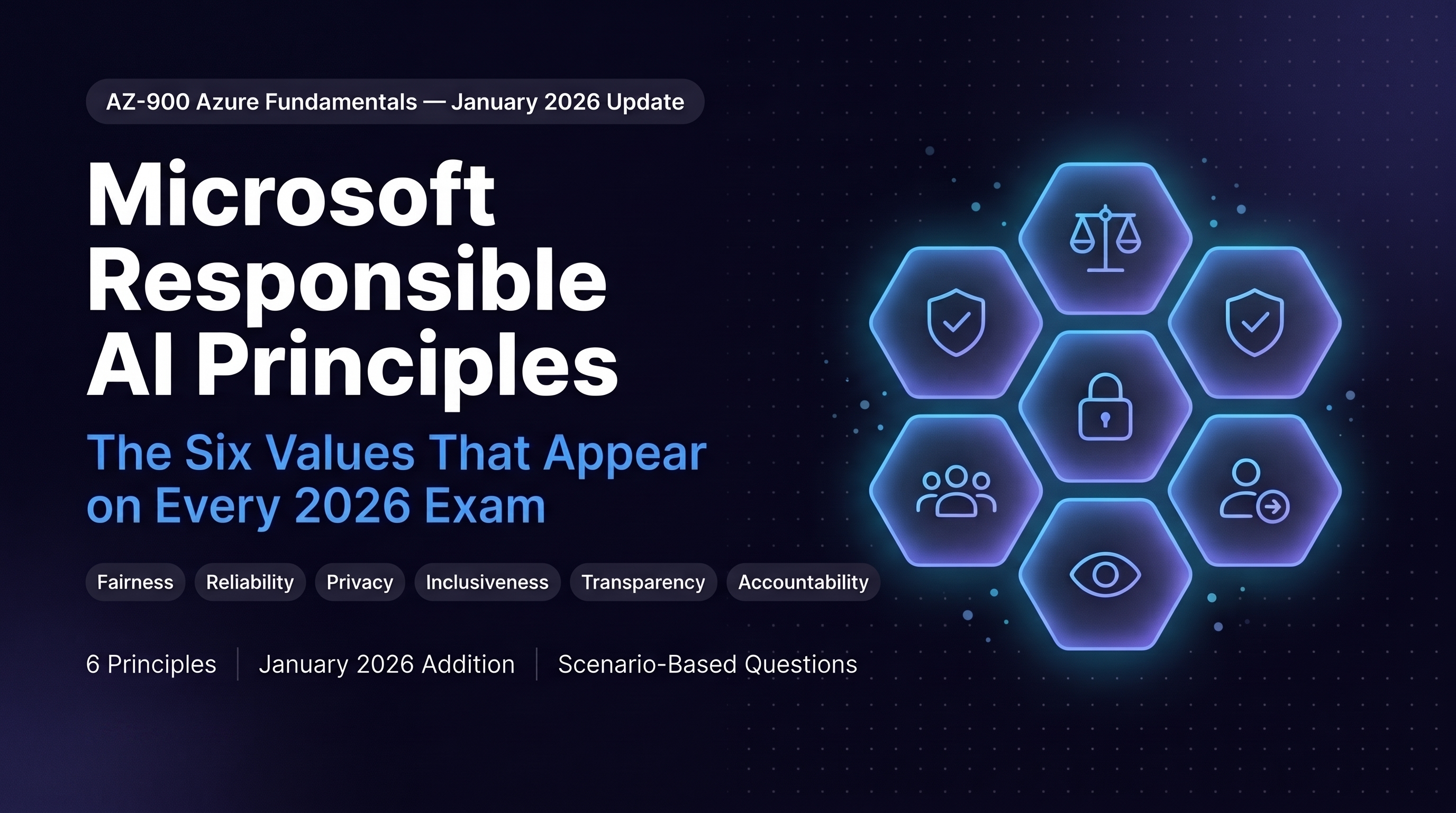
The Responsible AI Principles Question That Tricks Almost Everyone
You're three weeks into studying for AZ-900. You feel good. Cloud concepts make ...
AZ-900 Microsoft Azure Fundamentals: What It Actually Is and Whether You Should Take It
Maybe you saw "AZ-900" in a job description and had no idea what it meant. Maybe...