Security Plus 701 vs CC ISC2: The Question Nobody Gives You a Straight Answer To
You're standing at a fork in the road.
One sign says "[CompTIA Security+ SY0-701](https://www.certsinfinity.com/blog/comptia-security-plus-701-the-real-talk-on-exams-jobs-and-what-comes-next)." The other says "[CC ISC2](https://www.certsinfinity.com/blog/cc-isc2-the-cybersecurity-certificate-most-beginners-dont-know-exists)." Both point toward cybersecurity. Both claim to be the right starting point. And if you've spent more than twenty minutes Googling this, you've probably come across articles that confidently tell you to take Security+ first — and other articles that just as confidently tell you to start with CC.
So which one is it?
Here's what actually makes this confusing: both are genuinely good options, but for different people in different situations. The reason nobody gives you a straight answer is because there isn't one universal right answer. There's only the right answer for you — and figuring that out requires understanding what each cert actually is, not just what the marketing says about it.
Let's sort this out properly.
They're Not Really Competing — They're Different Depths of the Same Pool
The biggest misconception people carry into this decision is that Security+ and CC ISC2 are roughly equivalent options at the same level. They're not.
Think of it this way. CC is like learning to swim in a pool with an instructor beside you explaining what each stroke is and why it works. Security+ is getting into that same pool and being timed.
Both involve water. One assumes you've never been in before. The other assumes you're ready to actually perform.
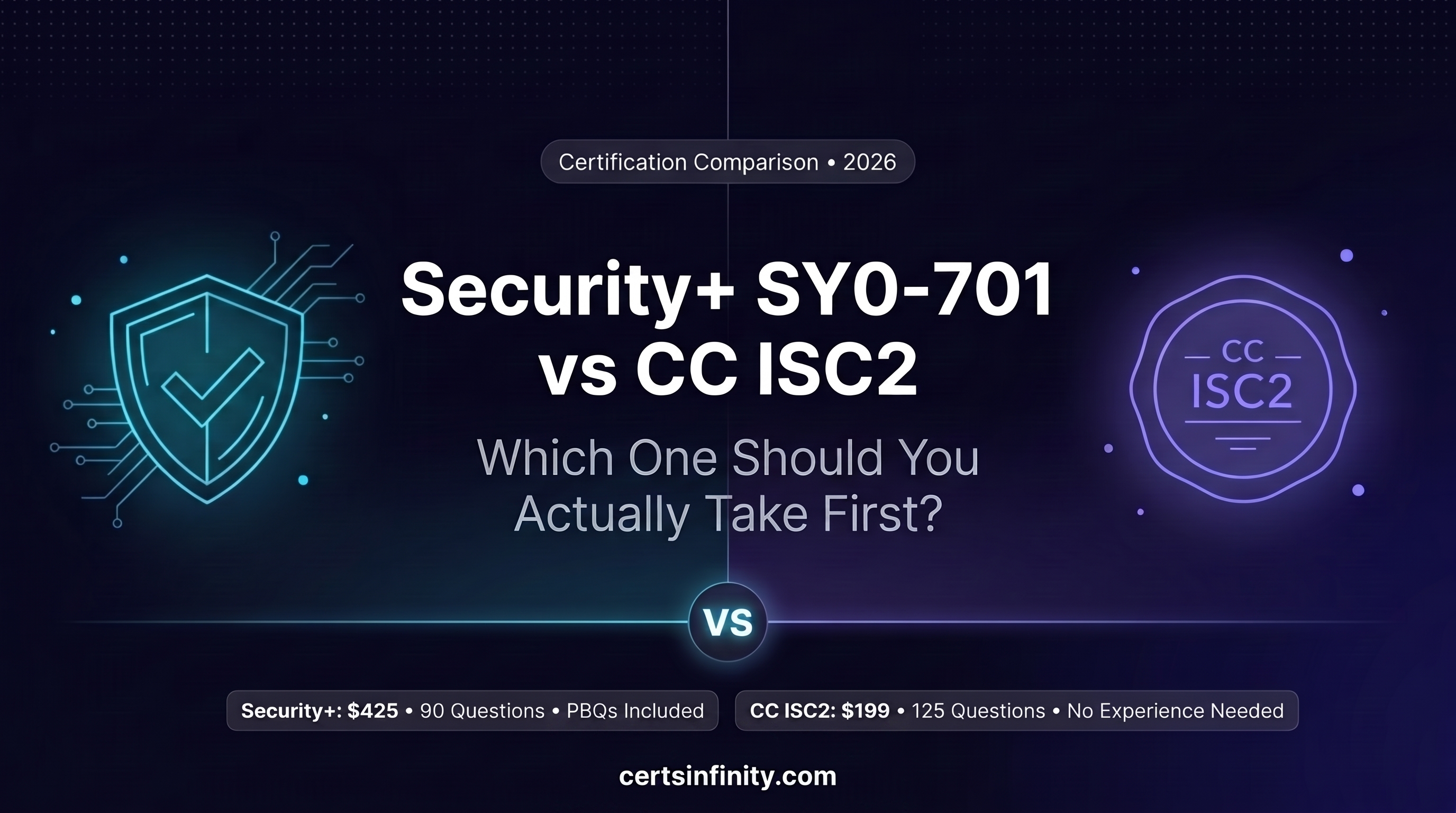
The ISC2 CC certificate is a pure foundational credential. Five domains, all multiple choice, no simulation tasks, designed specifically for people with zero IT background. It tests whether you understand the concepts of cybersecurity — what confidentiality means, how access control works, why business continuity planning matters. It's scored 700 out of 1000. You have two hours and between 100 and 125 questions.
The CompTIA Security+ SY0-701 exam goes a layer deeper. Same concepts, more technical application. It includes performance-based questions — actual simulations where you have to configure something, analyze a log file, or match a defence to a threat scenario. It's 90 minutes, up to 90 questions, and you need 750 out of 900 to pass. CompTIA recommends around two years of IT experience before sitting it — not mandatory, but the exam reads that way. If you don't have that background, some of the questions will feel like they're written in a different language.
The content between the two overlaps heavily, which is why passing CC first makes Security+ noticeably less painful — and going the other direction, a Security+ holder finds CC straightforward. They're not redundant in difficulty curve, even when the subject matter covers similar ground.
So Which One Should You Actually Take First?
Here's the honest filter: it comes down to where you're starting from.
If you're completely new to IT and feel intimidated by Security+, start with ISC2 CC. Build your foundation, gain confidence, then move to Security+. If you have some IT background and are serious about employment, you can go directly to Security+.
That's the clearest way to say it. But let me add some texture to that.
If you've never worked in IT — no help desk, no network support, no sysadmin work of any kind — jumping straight into comptia security plus 701 is possible but genuinely hard. The SY0-701 exam assumes you know what subnetting is, what a VLAN does, how Windows permissions work. It doesn't teach you those things. It tests whether you can apply security thinking on top of them. Without that foundation, you'll spend half your study time learning background knowledge you should already have.
CC doesn't assume any of that. It starts from scratch, and that's by design.
On the other hand, if you've been doing IT support for a couple of years and you're making a deliberate move into security, the comptia security 701 is the smarter investment. It carries more weight in job postings. In 2026, if you scan 100 entry-level cybersecurity job postings, you'll see Security+ listed in 50 to 70 of them and ISC2 CC listed in 10 to 20. That gap is real and it matters when you're applying for jobs.
What Each Exam Actually Tests — Without the Jargon
Both exams have something in common: they reward people who can reason through scenarios, not people who've memorized flashcards. Knowing that changes how you should study for either of them.
Here's what a CC-style question looks like in practice:
A company wants to ensure employees can still work if the main office becomes unavailable due to a flood. Which process does this describe?
A) Incident Response
B) Risk Assessment
C) Business Continuity Planning
D) Access Control Review
That's it. The logic is the test. No deep technical knowledge required — just whether you understand what business continuity planning is for.
Now here's what a sy0-701 exam question looks like:
A security analyst reviewing network logs notices repeated failed login attempts to an internal server from an IP address outside the company's known range, followed by one successful login at 2:47 AM. Which of the following should the analyst do FIRST?
A) Block the external IP address at the firewall
B) Reset the compromised account's password immediately
C) Preserve the log evidence and escalate to the incident response team
D) Notify affected users about the potential breach
See the difference? The Security+ question puts you in the middle of an actual situation. You're not being asked what incident response is — you're being asked to do it, in order, under a time constraint. That's what performance-based questions feel like, too, except with an actual interface to interact with.
This is exactly why working through isc2 certified in cybersecurity exam questions and sec 701 practice test materials before your exam matters so much. Reading about these concepts and answering questions about them under exam conditions are two completely different experiences. Practicing with isc2 cc practice questions specifically trains your brain to think in the format the exam uses — not just to recognize information when you see it.
The Cost Conversation Nobody Has Upfront
Let's talk money, because it actually affects which cert makes sense to take first right now.
The CC ISC2 standard exam fee is $199. After you pass, there's a $50 annual maintenance fee to keep the isc2 cc certificate active, plus 45 continuing education credits every three years. If you grabbed a free voucher from ISC2's One Million Certified program before May 20, 2026, you can still use it until December 31, 2026 — that's an extraordinary deal and worth using if you have one.
Security+ SY0-701 costs $425 for the exam voucher. Fail once and you're paying again, with a 14-day wait before your next attempt. Add study materials and you're realistically looking at $500 to $700 total for self-study. There's also the question of SY0-701's expected retirement — CompTIA typically refreshes Security+ every three years, putting a potential new version on the horizon in late 2026. Confirm the active exam version on CompTIA's site before you buy a voucher.
The practical implication: if you're genuinely new to IT and genuinely unsure about cybersecurity as a career direction, CC is a low-cost way to find out whether this field suits you before committing to the larger Security+ investment.
What Happens After You Pass — Honest Expectations
This is the part most comparison articles skip. Passing either cert doesn't automatically open a job offer. What it does is change which jobs you can reasonably apply for.
With an isc2 cc certificate, you're signalling genuine intent and foundational knowledge. That's meaningful at the entry level, especially if you pair it with a home lab or some documented self-study projects. But CC alone, without any IT background, will still require patience and persistence in a job search. It gets you into the conversation — it doesn't close it.
With Security+ SY0-701, particularly if you have some IT experience behind it, you're a competitive candidate for Tier 1 SOC analyst roles, junior security administrator positions, and IT support roles with security responsibilities. Security+ is the go-to cert for entry-level positions that require day-to-day security operations — monitoring threats, configuring security tools, responding to incidents. CC is a better starting point for those interested in security policies, compliance work, and governance rather than technical operations.
The career direction matters too. If you want to eventually move into hands-on security work — SOC analysis, penetration testing, incident response — Security+ is the more direct path. If you're drawn toward GRC, compliance, or policy work, CC is a perfectly valid foundation for that track.
For certified in cybersecurity isc2 study material and quality isc2 certified in cybersecurity exam questions, ISC2's own resources are the most accurate baseline, especially given the updated exam outline coming on September 1, 2026. Platforms like CertsInfinity offer practice question sets for both certs that are updated to reflect current exam blueprints — useful when you want broader question exposure beyond the official samples.
Questions From People In Exactly Your Situation
What's the best cybersecurity certification for beginners?
Depends on your starting point. Zero IT background — start with CC, then move to Security+. Some IT experience already — go directly to Security+ and you'll find the content manageable with focused study.
Can you get a cybersecurity job without a degree?
Yes, consistently. Employers increasingly prioritize demonstrated knowledge and initiative over specific academic credentials. A certification paired with a home lab or documented project carries real weight at the entry level, especially for junior roles.
Is 25 too late to start a cybersecurity career?
Not remotely. Career changers in their 30s and 40s are common in this field, not unusual. Many of the most effective security professionals came from completely unrelated backgrounds — teaching, finance, military, customer service. The field values how you think, not how long you've been doing it.
Do employers actually care about cybersecurity certifications?
Most do, specifically for entry-level screening where candidates don't yet have a work history in security. A cert gives a hiring manager something concrete to point to when comparing otherwise similar applications. Security+ carries more recognition in job postings right now, but CC is building its presence, especially in organizations familiar with ISC2's broader credentialing ecosystem.
Should you get Security+ or Network+ first?
If you have no networking background at all, Network+ first is genuinely helpful — it gives you the foundational networking knowledge that Security+ builds on. If you have some IT experience and understand basic networking concepts already, you can go directly to Security+ without Network+ first.
How long does it take to get cybersecurity certified?
CC: most candidates with no IT background need four to eight weeks of consistent study. Security+: eight to ten weeks with some IT background, twelve to sixteen weeks without it. These aren't pessimistic estimates — they're what realistic, focused preparation actually requires.
Can you work in cybersecurity with only a certificate?
For a first job, often yes — especially combined with a home lab, CTF participation, or documented personal projects. Long-term, most people layer additional certifications and real work experience on top. The cert gets you noticed; what you can demonstrate in an interview determines whether you get hired.
What's the fastest way to get into cybersecurity?
CC first if you need confidence and foundation. Security+ directly if you already have IT experience. Either way, pair it with hands-on practice — a home lab running on a free tool like VirtualBox, completed TryHackMe rooms, or any project you can speak to specifically in an interview. The certification opens the door; applied evidence makes employers want to see what's on the other side.
One Concrete Thing You Can Do Today
If you're still unsure which cert to take first, here's a practical test: find a free Security+ sample question set online and work through ten questions cold, without studying first. If you can reason through most of them — even without knowing the specific answers — you're probably ready to go straight to Security+. If the questions feel like they're written for someone with completely different context than you have right now, start with CC and build the foundation first.
Either path works. The only wrong move is spending another month deciding instead of starting.