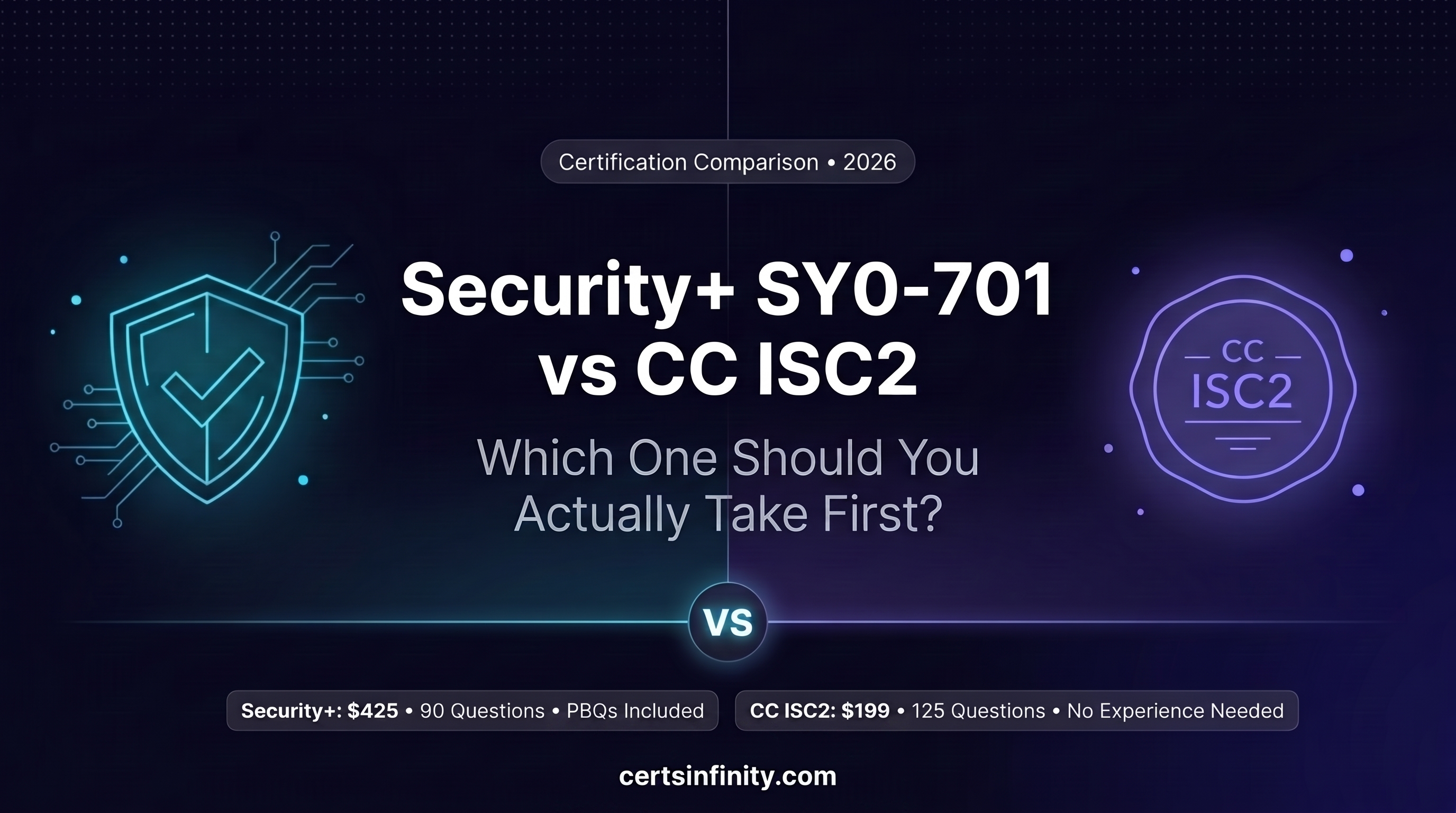
CompTIA Security Plus 701: The Real Talk on Exams, Jobs, and What Comes Next
There's a version of the Security+ conversation that goes like this: pass the exam, update LinkedIn, get hired into cybersecurity. Clean, linear, motivating. And then there's what actually happens for most people — which is messier, more nuanced, and ultimately more useful to understand before you invest your time and money.
The CompTIA Security+ SY0-701 is the most widely recognized entry-level cybersecurity certification in the world. Over 700,000 IT professionals currently hold it. It's DoD-approved, employer-recognized, and genuinely useful as a foundation for a security career. But it's also misunderstood — both by people who overestimate what it will do for them and by people who write it off as "too basic." The truth sits somewhere more practical than either of those takes.
This is the full picture: what the exam looks like, how to actually prepare for it, what it costs, what it's worth on the job market, and what people who've already passed it wish someone had told them earlier.
Security+ SY0-701 — Why the Version Number Actually Matters
If you've been researching this certification for a while, you may have come across older study guides, YouTube playlists, or Reddit threads referencing SY0-601. Set those aside. SY0-601 was officially retired on July 31, 2024. SY0-701 is the only active Security+ exam today, and it's a meaningfully different test.
Six domains became five. The old standalone "Implementation" domain was absorbed into Architecture and Operations. Cloud and hybrid content expanded significantly. Zero Trust became a named, testable concept — not optional background reading. Automation and orchestration (SOAR), EDR/XDR, and AI-driven threat coverage were added. Security Operations grew to 28% of the exam, the largest single domain by a significant margin.
SY0-601 study materials cover roughly 80% of what SY0-701 tests — but the missing 20% is concentrated in cloud security, zero trust, and automation content, which is exactly where the exam leans hardest on scenario questions. Studying from outdated material builds false confidence in precisely the areas most likely to cost you points.
One more thing worth knowing: CompTIA typically retires Security+ versions three years after launch. SY0-701 launched in November 2023, which puts its estimated retirement window in late 2026. Before you register, confirm the current active exam version at CompTIA.org. If a new version has been announced by the time you're reading this, verify that your study materials are aligned to whatever's current.
What the SY0-701 Exam Actually Looks Like
Knowing the format before you start studying changes how you prepare. The SY0-701 has up to 90 questions and lasts 90 minutes — roughly one minute per question at the tightest pace. The passing score is 750 out of 900, which is scaled, not a straight percentage. Because the scoring is compensatory, strength in one domain can offset a weaker one — you don't need to clear a separate bar in each section, only hit 750 overall.
The five domains and their weights are:
- Security Operations — 28%
- Threats, Vulnerabilities, and Mitigations — 22%
- Security Program Management and Oversight — 20%
- Security Architecture — 18%
- General Security Concepts — 12%
Security Operations carries more than a quarter of your total score. Most candidates don't study it proportionally — and that's exactly why they lose points they could have kept.
Beyond standard multiple-choice, the exam includes performance-based questions (PBQs): hands-on simulation scenarios where you work through a real security task rather than selecting from four options. PBQs appear at the front of the exam, take longer than multiple-choice questions, and carry more weight per item. The move that works for most candidates is to flag every PBQ at the start, work through the multiple-choice section to build momentum and bank guaranteed points, then return to PBQs with whatever time remains. One drag-and-drop question that consumes 15 minutes is not a good trade.
You can sit the exam at a Pearson VUE testing center or through OnVUE online proctoring from home. Both use the same questions and lead to the same certification. If you go the online route, take the room setup seriously — a phone in view, a second monitor plugged in, or someone walking through the room can pause or void your exam. Clear the space thoroughly before you start.
Is Security+ SY0-701 Harder Than You Think?
This is one of the most searched questions about the exam, and the honest answer is: for people who underestimate it, yes — significantly.
Security+ has a reputation for being "entry level," and candidates sometimes take that to mean straightforward. What it actually means is that it doesn't require hands-on engineering experience to pass — not that the concepts are shallow or that memorizing a glossary will get you through. SY0-701 specifically shifted toward scenario-based and applied questions. You're not being asked to define what a SIEM is. You're being asked to read a log output and identify what it indicates, or to choose the right control for a described architectural situation.
The exam reduced its objectives from 35 (in SY0-601) to 28 — but the remaining topics are tested at greater depth. Fewer topics, harder questions. That's the accurate summary of what changed.
CompTIA doesn't publish an official pass rate for Security+. Community data from r/CompTIA and r/SecurityCareerAdvice suggests first-attempt pass rates in the range of 70–80% for candidates who prepared seriously — lower for those who relied primarily on memorization rather than concept application. The candidates who struggle most are those who know what things are called but can't reason through what they'd do in a real scenario.
How to Study for CompTIA Security 701 Without Wasting Time
Most Security+ study failures aren't failures of effort — they're failures of strategy. People study the wrong things, in the wrong proportions, using resources that don't match how the exam actually tests.
A framework that works:
Step one: Get the official exam objectives. They're free on CompTIA.org. Every question on SY0-701 maps to something on that list. Every hour you spend studying something not on that list is an hour not spent on what matters. Use the objectives as your master checklist — mark what you know, mark what's new, and build your plan around the gaps.
Step two: Don't skip Domain 1 because it's worth the least. General Security Concepts is 12% of the exam but it's the vocabulary the other four domains use. Candidates who rush past it make careless errors across every other section because they can't quickly classify controls, apply CIA triad reasoning, or reason about cryptographic requirements. Spend at least a week here before moving forward.
Step three: Invest in Domain 4 like it's 28% of your score — because it is. Security Operations contains the highest proportion of PBQ content. Reading about incident response isn't the same as working through it. Set up a free virtual lab, practice reviewing Windows Security Event Logs, and get some exposure to Splunk or ELK if you can. The candidates who come into Domain 4 PBQs having actually done these things have a measurable advantage over those who've only read about them.
Step four: Use practice questions diagnostically, not just evaluatively. Scoring 82% on a practice set feels good. Understanding why the 18% went wrong is what actually improves your score. Review every missed question until you understand the reasoning — not just which letter is correct but why the other three are wrong. CompTIA loves questions where two answers look plausible and the distinction is a specific, testable detail.
For practice materials, the key variable isn't which platform you use — it's whether the questions are current. The sec 701 practice test landscape includes plenty of outdated question banks that were built for SY0-601 and never properly updated. Platforms like CertsInfinity maintain real exam questions aligned to the current SY0-701 blueprint, which matters specifically for the cloud, zero trust, and automation content that older resources typically miss. Whatever you use, verify when the question bank was last updated before you commit time to it.
When are you ready to book? When you're consistently scoring above 80% on full-length timed practice exams and can explain — out loud, not just in your head — why wrong answers are wrong. That's the bar that tends to correlate with first-attempt passes.
Can You Study for Security+ While Working Full-Time?
Yes — and most people who pass it do exactly that. The realistic timeline for a working professional with an IT background is eight to ten weeks at roughly one to two hours on weekdays and three to four hours on weekends. Without an IT background, extend that to fourteen to sixteen weeks. These aren't pessimistic estimates — they're what consistent, focused preparation actually requires for most people.
The one rule that separates candidates who pass from those who almost pass: don't move forward until your practice scores in the current domain are consistently above 75%. Rushing through material to hit an arbitrary exam date is how people pay for retakes.
A practical week structure looks like: read and watch on weekdays, do practice questions on weekends, and dedicate one full weekend per domain to timed practice before moving to the next. By week seven or eight, shift almost entirely to full-length timed practice exams and review. Walk into exam day having seen the PBQ format enough times that it's familiar, not surprising.
What the CompTIA Security+ SY0-701 Exam Actually Costs
As of June 2026, the official CompTIA exam voucher costs $439 USD purchased directly from CompTIA — up from $425 earlier in the year. That's one attempt. There's no free retake; if you need to sit again, you buy another voucher at the same price.
The good news is that authorized resellers consistently sell the same voucher for less — $373 to $410 is a realistic range from legitimate CompTIA partners. Same exam, same Pearson VUE proctoring, same certification. Buying from an authorized reseller is genuinely the easiest cost saving available, and it's worth doing before you pay full retail.
If exam nerves are a real factor, retake bundle options exist — typically around $100 extra — that cover a second attempt without paying full price again. If you're not confident about your readiness, that's the cheapest insurance available.
What the full investment looks like in practice: the voucher at $373–$439, a study guide at $40–$60, quality practice exam access at $30–$60, and optional video instruction at $0 (Professor Messer's free YouTube content is legitimately useful) to $289 for a structured course. Self-study all-in typically runs $500–$700. Bootcamp routes can reach $1,500–$3,500, though they often include the voucher and structured support.
Students can access academic discounts of 40–50% through CompTIA's academic store — a detail that's easy to overlook but significant if you qualify. And like any professional certification, Security+ is a common employer reimbursement. Ask your company before you pay out of pocket — many organizations cover the full exam fee for employees pursuing security credentials. The certification is valid for three years, renewable through CompTIA's Continuing Education program for roughly $150 over the cycle.
Will Security+ Get You a Job With No IT Experience?
This is the question that fills r/CompTIA and r/CyberSecurityJobs every week — and it deserves a direct answer rather than a motivational one.
The honest answer is: it depends on what "no IT experience" actually means, and most people asking this question are underselling what they actually have.
True entry into cybersecurity from a completely non-technical background with only a certification is possible but genuinely difficult. The global cybersecurity talent shortage is real — 4.8 million unfilled positions according to ISC2's 2024 Workforce Study — but that shortage is concentrated at the experienced and specialized level, not at the junior tier. Entry-level security roles still receive competitive applications, and most of them quietly filter for some form of adjacent background: help desk, IT support, network administration, even a well-documented home lab.
According to ISC2's 2025 Hiring Trends data, 89% of employers now accept entry-level certifications in place of a degree, and 90% consider candidates with only IT experience. The door is open — but "only certification, no experience of any kind" is a harder case to make than most study guides admit.
What moves the needle if you're coming in without traditional IT experience: a home lab you can describe specifically in an interview, TryHackMe or Hack The Box rooms completed and documented, volunteer IT work for a school or nonprofit, or a self-documented project that shows you've applied security concepts in practice. These aren't resume decoration — they're evidence that you can do things, not just that you passed an exam.
From Tech Support to Cybersecurity: Does Security+ Actually Help?
For anyone already working in IT support, helpdesk, or network administration, Security+ is one of the highest-leverage moves available. And this path has a much cleaner success rate than the "no experience" route above.
Here's why: tech support work gives you real exposure to systems, real troubleshooting experience, and real understanding of how IT environments operate. Security+ formalizes the security layer on top of that foundation. The combination — documented IT experience plus Security+ certification plus some security-specific projects or study — is a genuinely competitive profile for entry-level security roles.
Hiring managers at SOC teams and security operations roles consistently say they prefer candidates who understand how systems work before they learn how systems break. Help desk and IT support work is exactly that foundation. If you're currently in tech support and considering Security+, you're already better positioned than someone starting from scratch, even if your resume doesn't say "security" anywhere yet.
What Jobs Can You Actually Get With Security+ Certification?
One important clarification before the role list: employers don't post jobs titled "Security+." The certification is a credential, not a job role. If you search job boards expecting to see the certification name in the title, you'll come up empty. Search instead for roles where cloud literacy and security fundamentals matter — and the field opens up.
The roles where Security+ carries direct weight:
SOC Analyst Tier 1 — The most direct entry point into hands-on security work. Monitoring alerts, triaging incidents, escalating what needs deeper investigation. True entry-level SOC roles pay $55,000–$75,000; with one to two years of IT background, $70,000–$85,000. Security+ is frequently listed as a minimum requirement at MSSPs and enterprise security operations teams.
GRC Analyst (Governance, Risk, and Compliance) — A less technical but highly valuable track for candidates with backgrounds in project management, law, finance, or business. GRC roles involve compliance frameworks, risk assessments, and audit support. Pay range: $60,000–$80,000 at entry level.
Security Administrator — Managing user access, maintaining security tools, reviewing logs, handling day-to-day security operations. Overlaps with senior sysadmin work. Pay range: $60,000–$80,000.
IT Support with Security Responsibilities — Underestimated as a career entry point, but support roles at companies with active security programs expose you to real incidents, real tools, and real escalation processes. Security+ on top of that experience becomes a strong combination for moving into dedicated security roles within 12–18 months.
DoD and Government Contractor Roles — This is the category most candidates overlook. Security+ is a DoD 8570/8140-approved credential, which means federal agencies and defense contractors — Lockheed Martin, Booz Allen Hamilton, Leidos, SAIC — actively require or prefer it. Many of these positions come with security clearance sponsorship, and a Top Secret clearance in a cybersecurity role adds roughly $20,000 annually to compensation. Government Jobs That Require Security+ is one of the most underexplored paths for new certificate holders.
On salary: entry-level Security+ roles realistically pay $60,000–$85,000 depending on role, location, and prior experience. Mid-level security analysts with two to three years of experience reach $90,000–$120,000. The Bureau of Labor Statistics reports a median salary of $124,910 for information security analysts — a figure that includes experienced professionals but reflects the real ceiling this career path reaches.
Security+ Passed But No Job Offers — What's Actually Going Wrong?
This comes up constantly in r/SecurityCareerAdvice and r/CompTIA. Someone passes, updates LinkedIn, starts applying, and hears nothing for weeks. The pattern is common enough that it deserves a specific breakdown rather than generic encouragement.
The most frequent reasons:
Targeting the wrong roles. Most people apply to "Cybersecurity Analyst" or "Security Engineer" roles and wonder why they're not getting callbacks. Those roles typically want two to five years of hands-on experience. Security+ doesn't bridge that gap. Target Tier 1 SOC, Junior Security Administrator, GRC Analyst, or IT Support with Security responsibilities — that's where the certification actually differentiates you.
A resume that lists the certification but shows no evidence of applied skill. Hiring managers at entry level are looking for proof you've done something with your knowledge — even if that's a home lab, a documented CTF run, or a project. A certification line in a resume is a checkbox; what gets you an interview is showing that you've actually used what you learned.
Timeline expectations that are too short. Getting your first security-adjacent job commonly takes three to six months of consistent, targeted effort. Not three to six weeks. The talent shortage is real but it's concentrated at the experienced level. Entry-level competition is genuine.
Score anxiety that doesn't reflect employer reality. If you scored 723 and passed (750 is the cutoff — so 723 is a fail, but if you passed with 751 or 760), employers don't see your score. They see "passed" or "not passed." A minimal pass and a high pass are the same credential to an employer. What matters is whether you can demonstrate the knowledge in an interview, not what number appeared on your score report.
Security+ Still Valid in 2026 — and What Comes Next
Despite occasional noise about the certification being "saturated" or "too common," Security+ remains the credential most cybersecurity hiring managers look for first at the entry level. It appears in more job listings than any comparable certification, it's DoD-approved, and it provides the foundational vocabulary that every subsequent security credential builds on.
What's changed is the expectation around it. In 2018, Security+ was a differentiator. In 2026, it's closer to a baseline — something many candidates have, which means having it gets you in the pool but doesn't automatically separate you from it. The candidates who convert interviews to offers are those who pair the certification with demonstrable applied skills: a home lab, CTF results, a GitHub repo with security projects, or relevant work experience.
The most natural progression after Security+ depends on which direction you're heading:
For security analysis and SOC work, CySA+ is the logical next step — it tests at a deeper analytical level and is frequently listed alongside Security+ in analyst job descriptions. For those heading toward offensive security and penetration testing, CEH provides an intermediate credential before OSCP, which remains the gold standard for hands-on offensive work. For cloud security, pairing Security+ with AWS Security Specialty or Microsoft SC-900/SC-200 is increasingly relevant as cloud infrastructure becomes the default environment for most organizations. For those targeting management and architecture over time, CISSP is the long-term credential — though it requires five years of verified experience, so it's a goal rather than an immediate next step.
The career path most people follow looks like: Security+ → entry-level security or adjacent IT role → 12–18 months of hands-on experience → CySA+ or a specialization → mid-level security analyst or engineer. That trajectory, built steadily, leads to the $90,000–$120,000 mid-career range within three to five years.
FAQs — Real Questions, Straight Answers
Will Security+ get me a job with no IT experience?
It helps, but it works best paired with evidence of applied skill — a home lab, CTF participation, or documented projects. The certification validates that you understand security fundamentals; the portfolio demonstrates you can use them. Without any IT background at all, plan for a longer search and consider targeting help desk or IT support roles as an entry point into security.
How many questions are on the Security+ exam?
Up to 90 questions in 90 minutes. Some candidates receive fewer, but prepare as if you'll get the full set. The exam includes multiple-choice and performance-based questions (PBQs). You need 750 out of 900 to pass.
Is Security+ SY0-701 harder than you think?
For most candidates who underestimate it, yes. It's scenario-based and operationally focused — not a vocabulary test. The shift from SY0-601 to SY0-701 reduced the number of objectives but increased the depth at which remaining topics are tested.
Security+ at 751 score — is that good enough for employers?
Yes. Employers see "passed" — not your score. A 751 and an 899 are the same credential. What matters in interviews is whether you can discuss the concepts, not what number appeared on your report.
What jobs can you get with just Security+ certification?
SOC Analyst Tier 1, GRC Analyst, Security Administrator, IT Support with security responsibilities, and federal/DoD contractor roles. These are realistic targets. Senior security engineer or architect roles require more experience and additional credentials.
From tech support to cybersecurity — does Security+ help?
Significantly. IT support experience plus Security+ is a stronger combination than Security+ alone. The support background gives you systems context that security work builds on directly.
Security+ passed but no job offers — what's going wrong?
Most commonly: targeting roles that require more experience than Security+ alone qualifies you for, a resume that lists the certification without showing applied skill, or a job search timeline that's too short. Refocus on Tier 1 SOC and GRC roles, add demonstrable projects to your profile, and give the search three to six months of consistent effort.
Security+ exam cost — is it worth the price?
At $439 for the voucher (or $373–$410 through authorized resellers), with a realistic total investment of $500–$700 for self-study, the return is strong for anyone targeting security roles. Entry-level positions pay $60,000–$85,000; mid-level roles reach $90,000–$120,000. The investment pays for itself quickly if you use the credential to actually pursue those roles.
Can you study for Security+ while working full-time?
Yes — most people who pass it do exactly that. Eight to ten weeks with an IT background, fourteen to sixteen weeks without one. One to two hours on weekdays, three to four on weekends, consistently applied, is enough.
Is Security+ still valid in 2026?
Yes. It remains the most widely recognized entry-level cybersecurity credential, DoD-approved, and present in more entry-level security job listings than any comparable certification. What's changed is that it's now closer to a baseline than a differentiator — which means pairing it with demonstrated applied skills matters more than it used to.
CertsInfinity provides regularly updated real exam questions for CompTIA Security+ SY0-701, aligned to the current exam blueprint and verified by cybersecurity professionals. Trusted by over 50,000 IT professionals. Visit certsinfinity.com to start your prep.