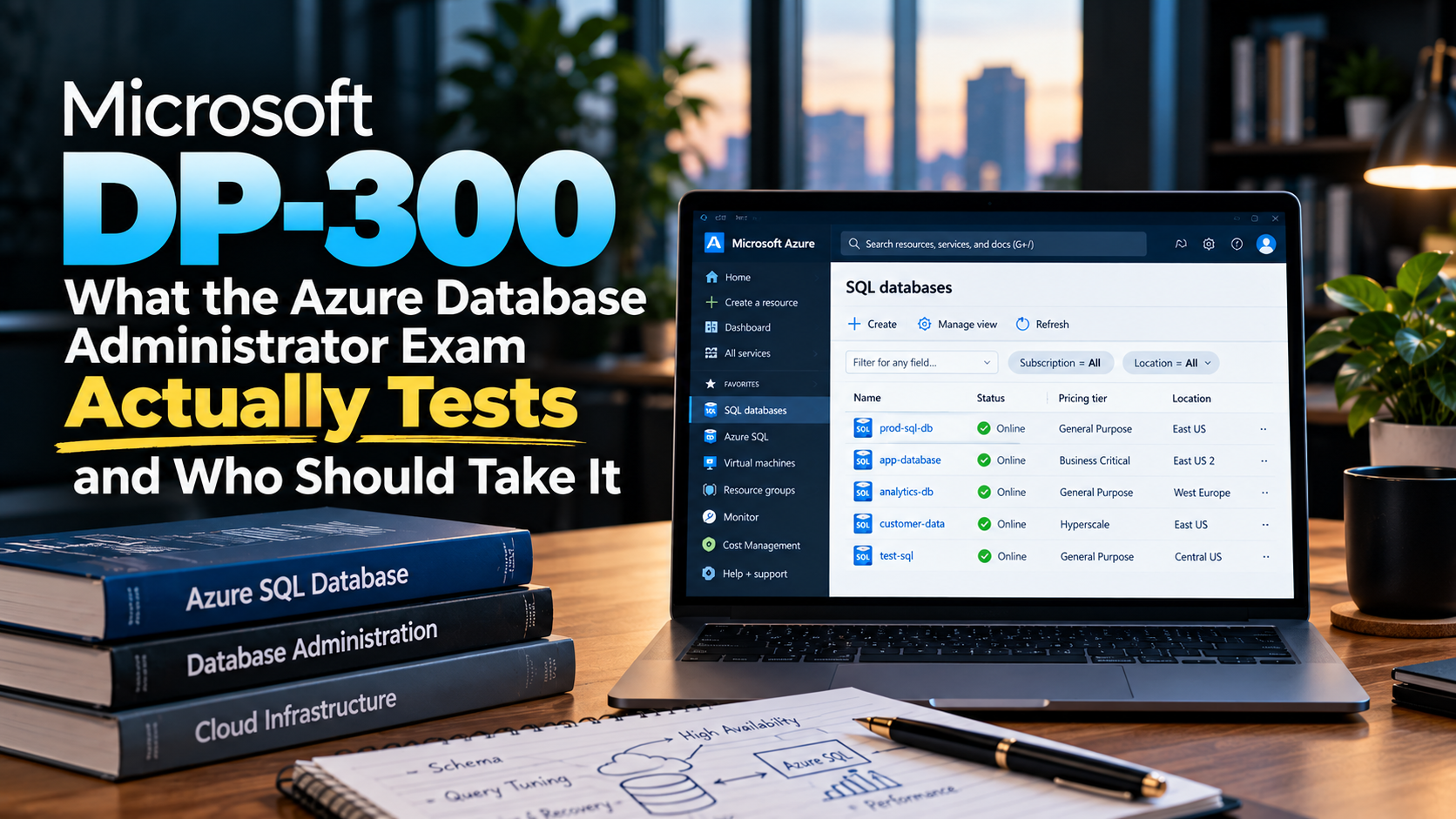
Microsoft DP-300: What the Azure Database Administrator Exam Actually Tests and Who Should Take It
There is a version of this decision that goes smoothly. You have been working with SQL Server for a couple of years. You are comfortable with Azure SQL Database. Your manager suggests DP-300 as a natural next step, and it genuinely is one. You study, you sit, you pass, and the certification validates work you were already doing.
Then there is the version where things are less clear. You have SQL skills but you are not sure if they are the right SQL skills. You have heard about DP-300 from a job description that also listed six other requirements you do not have. You are trying to figure out if this certification is a real career accelerator or just an expensive checkbox.
This article is honest about both versions.
The dp 300 certification is Microsoft’s associate-level credential for Azure database administrators. Passing the exam earns you the Microsoft Certified Azure Database Administrator Associate designation, which is one of the more directly applicable role-based certifications Microsoft offers. It is not a general cloud awareness credential like AZ-900. It validates that you can actually administer Azure database environments, which means the exam is harder, the preparation is more demanding, and the career return is more concrete for the right candidate.
What the microsoft dp-300 Exam Actually Is
The full exam name is Administering Microsoft Azure SQL Solutions. That name is more descriptive than the exam code, because it tells you specifically what the exam is about: administering SQL solutions in Azure, not all Azure database services and not all cloud administration generally.
Microsoft DP-300 focuses specifically on Azure SQL Database, Azure SQL Managed Instance, and SQL Server running on Azure Virtual Machines. If you work with PostgreSQL, MySQL, or Cosmos DB as your primary database technology, those are not the focus of this exam. There are other Microsoft certifications that cover those services. DP-300 is specifically the SQL path.
The exam is delivered through Pearson VUE, costs $165 USD, runs for 120 minutes, and includes 40 to 60 questions. The question formats are not limited to multiple choice. Case study questions, drag-and-drop questions, and scenario-based items all appear on the exam. The passing score is 700 out of 1000 on Microsoft’s scaled scoring system. Microsoft estimates the industry pass rate at around 65 percent, which is lower than most foundational-level exams and reflects the hands-on nature of what the exam tests.
The certification renews annually. On-time renewal is free through a non-proctored assessment on Microsoft Learn. A lapsed certification requires the full exam and fee to reinstate.
The Four Domains and What Each One Means
The azure dp 300 exam is built around four skill areas. The weights matter for how you allocate preparation time, and the largest domain is not the most obvious one.
Plan and Implement Data Platform Resources — 20 to 25 percent
This domain covers deploying Azure SQL Database, Azure SQL Managed Instance, SQL Server on Azure Virtual Machines, and Elastic Pools. It includes migrating on-premises SQL Server workloads to Azure, selecting the right deployment option for a given scenario, and configuring the platform-level settings that affect database behavior.
The scenario questions in this domain typically present a business situation with specific requirements around cost, performance, compatibility, and managed service overhead, and ask you to identify which Azure SQL option fits best. Knowing the feature parity differences between Azure SQL Database, Managed Instance, and SQL Server on VMs is essential here. Each option sits at a different point on the managed-to-unmanaged spectrum, and the exam tests whether you can match requirements to the right position on that spectrum.
Implement a Secure Environment — 20 to 25 percent
Network security, authentication, authorization, encryption, and auditing for Azure SQL environments. This domain covers configuring Microsoft Entra ID authentication, implementing the principle of least privilege through database and object-level permissions, configuring Always Encrypted and Transparent Data Encryption, and setting up auditing and Microsoft Defender for SQL.
The security domain carries the same weight as the implementation domain, which surprises candidates who expect hands-on administration skills to dominate the exam. Microsoft weights security heavily because data breaches involving misconfigured database environments are a consistent and expensive problem, and the certification is designed to verify that certified administrators know how to prevent them.
Monitor, Configure, and Optimize Database Resources — 30 to 35 percent
The largest domain on the exam. This covers performance monitoring and tuning, Query Store, Intelligent Query Processing, index optimization, Azure SQL Insights, alerting, and managing database resources for cost and performance efficiency.
Thirty to thirty-five percent of the exam is on this domain. That is roughly a third of your total score. Most candidates who pass DP-300 consistently say this is both the most practically useful domain and the one that requires the most hands-on preparation. Reading about query plan analysis and index recommendations does not build the same skill as actually diagnosing a slow query in Query Store and identifying which index change would fix it. If you have limited time, this domain deserves the most of it.
Configure and Manage Automation of Tasks — 20 to 25 percent
Azure Automation, SQL Agent, elastic jobs, alerting, and automated database maintenance tasks. This domain tests whether you can build reliable automated workflows for routine database administration operations and configure appropriate notifications when those operations succeed or fail.
Who Should Actually Take This Exam
The honest profile for a DP-300 candidate is someone with two or more years of database administration experience, specifically with SQL Server or Azure SQL, who is moving their work into or deeper into Azure environments.
That experience requirement is not a formal prerequisite. Microsoft does not bar you from registering without it. But the exam is calibrated for that background. Scenario questions assume you already understand relational database concepts, T-SQL, and SQL Server administration basics. The exam does not teach those things. It tests whether you can apply them in Azure-specific contexts.
Candidates who come in with strong SQL Server on-premises experience and limited Azure exposure find the exam hard but manageable with focused Azure preparation. Candidates who are strong on Azure but limited on SQL Server find the database-specific depth of the exam harder to bridge quickly. Candidates who are new to both databases and Azure should consider starting with DP-900, the Azure Data Fundamentals certification, before attempting DP-300.
The roles where this certification carries direct weight are Azure Database Administrator, Cloud DBA, Data Platform Engineer, SQL Server DBA moving to cloud, and Database Reliability Engineer. It is most relevant to people doing database administration work, not data analysis, data science, or business intelligence work. If your primary tool is Power BI rather than SQL Server Management Studio, PL-300 or PL-400 are more relevant credential paths.
What the dp-300 reddit Community Says
Reddit discussions about dp-300 in r/AzureCertification and r/sqlserver are consistent on a few things that are worth knowing before you sit.
Candidates who passed consistently say two things: the exam is harder than they expected because of the case study questions, and hands-on practice in Azure is non-negotiable. Reading the Microsoft documentation and working through Microsoft Learn modules is not sufficient preparation on its own. The exam tests whether you can diagnose situations and make decisions, not whether you can recall definitions.
The specific complaint that appears most often from candidates who failed on the first attempt: they prepared primarily with multiple-choice practice questions and were caught off guard by the case study format. Case study questions present a detailed scenario across multiple pages and ask several questions against that single scenario. Managing time and context across those questions is a specific skill that requires practice.
The honest good news: candidates who retook the exam after addressing their case study preparation almost universally passed on the second attempt. The exam is not ambiguous or unfair. It tests practical skills, and practical skills can be built with the right preparation approach.
The Salary and Career Return
Microsoft DP-300 certification leads to roles that sit at a meaningful compensation level. Azure Database Administrators in the United States earn between $90,000 and $130,000 annually depending on experience level and geographic market. Senior Azure DBA and Data Platform Engineer roles at the top of that range require several years of post-certification experience rather than the certification alone.
The more immediate career impact of DP-300 is in job market access rather than immediate salary transformation. Organizations running Azure SQL environments at scale specifically screen for this certification when hiring DBAs because it verifies a baseline of practical knowledge that is expensive to build on the job. A candidate with DP-300 and two to three years of SQL Server experience is a genuinely competitive applicant for mid-level Azure DBA roles. Without the certification, the same candidate competes against a larger and less differentiated pool.
For existing database administrators at organizations moving workloads to Azure, the certification validates skills the transition requires and often directly supports a case for compensation adjustment or role reclassification. That internal career impact is worth factoring into the return calculation alongside the job market considerations.
How to Prepare — Where to Start
A realistic preparation timeline for DP-300 is six to ten weeks for candidates with strong SQL Server experience. Without that experience, extend to twelve to sixteen weeks and expect to spend significant time building the SQL foundation before the Azure-specific content makes sense.
The preparation sequence that works consistently: Microsoft Learn’s DP-300 learning path for conceptual coverage, a free Azure SQL trial environment for hands-on practice, and scenario-based practice questions for exam format familiarity. Mixing all three simultaneously from week two onward is more effective than completing them sequentially.
For dp 300 exam questions that reflect the current exam blueprint and include the case study format that catches many first-time candidates, CertsInfinity’s DP-300 practice materials cover all four domains with full explanations: certsinfinity.com/vendors/microsoft/dp-300
Frequently Asked Questions
What is the DP-300 certification and will it help me get a job?
DP-300 is Microsoft’s Azure Database Administrator Associate certification. It validates SQL administration skills in Azure environments. For candidates with SQL experience moving into cloud database roles, it directly improves job market access for Azure DBA positions. For candidates without database experience, it is not a substitute for foundational SQL skills.
How much does the DP-300 exam cost?
$165 USD at standard pricing. Regional variations apply. Confirm the current price on Microsoft Learn before registering. No formal prerequisites means the $165 voucher is the primary upfront cost, though study materials and Azure sandbox time add to the total investment.
Is the DP-300 exam hard?
Harder than most foundational certifications. The 65 percent estimated industry pass rate reflects the hands-on nature of what the exam tests. Case study questions and scenario-based items require diagnostic reasoning rather than recall. Candidates with genuine SQL Server experience who add focused Azure preparation consistently pass.
Do I need SQL experience before taking DP-300?
Not formally, but practically yes. The exam assumes you understand relational databases, T-SQL, and SQL Server administration. Candidates without that background find the exam significantly harder. Consider DP-900 as a starting point if you are new to both Azure and databases.
How long does it take to prepare for DP-300?
Six to ten weeks for candidates with strong SQL Server experience. Twelve to sixteen weeks for those building database fundamentals alongside Azure knowledge. Hands-on lab time is not optional — it is where the exam’s most heavily weighted domain, Monitor and Optimize, actually gets learned.
Is DP-300 worth it for data analysts or only DBAs?
Primarily for DBAs and database engineers. The exam focuses on administration, security, performance tuning, and automation of SQL workloads, not data analysis or reporting. Data analysts whose primary tool is Power BI or who work primarily with structured datasets for analysis would find PL-300 more directly relevant to their work.
What happens if you fail the DP-300 exam?
You can retake it. Microsoft requires a 24-hour waiting period after a first failure before rebooking. A second failure requires a 14-day wait. Subsequent failures each carry a 14-day wait, up to a maximum of five attempts per 12-month period. Each attempt requires the full $165 fee.
DP-300 renewal: how often do you need to recertify?
Annually. Microsoft Certified role-based certifications renew every 12 months. On-time renewal is free through a non-proctored assessment on Microsoft Learn. The renewal assessment is shorter and less intensive than the original exam. A lapsed certification requires the full exam and fee to reinstate.
One Thing to Do Before You Register
Honestly assess where your SQL Server experience stands before you book. If you can troubleshoot a slow query, understand execution plans, configure Always Encrypted, and explain the difference between Azure SQL Database and Managed Instance, you are in a strong starting position.
If those concepts are unfamiliar, spend two to three weeks with SQL Server before you approach the Azure-specific content. The exam will not teach you the SQL fundamentals. It will test how you apply them in Azure contexts. That distinction determines whether six weeks of focused preparation is enough or whether you need considerably more.
For DP-300 practice questions and exam preparation materials aligned to the current exam blueprint: certsinfinity.com/vendors/microsoft/dp-300