
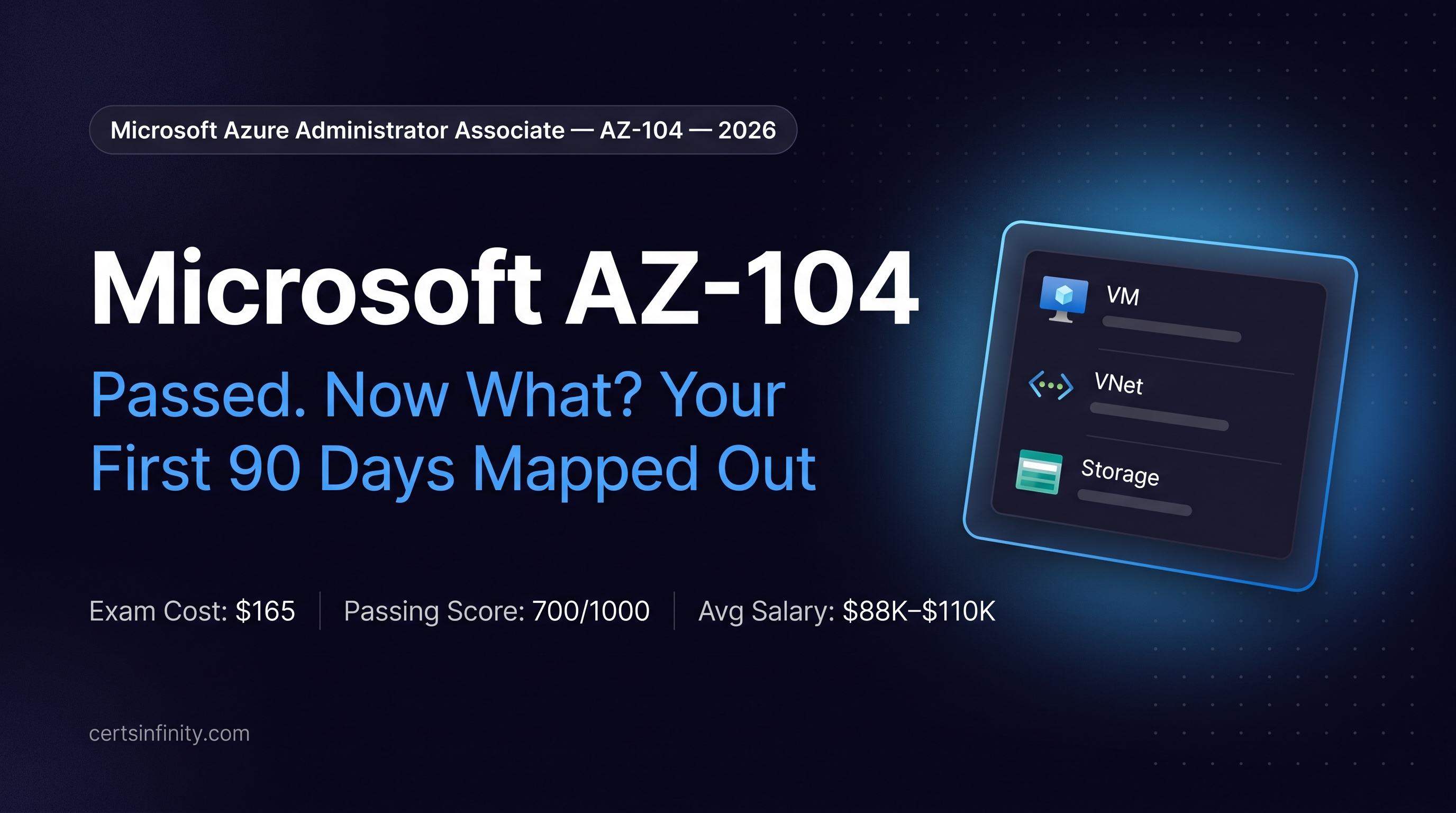
Microsoft AZ-104 Passed. Now What? The First 90 Days Nobody Prepares You For
You passed.
You remember the exact moment — the screen went blank for a second, then the word appeared. Pass. Score: 782. You probably sat there for a moment just staring at it.
Then you walked out, told a few people, got some congratulations, updated your LinkedIn. And then, maybe a day or two later, a quiet question crept in that nobody warned you about.
Now what?
The study plan is gone. The clear daily goal — get through these domains, hit 80% on practice tests, book the exam — that's all finished. And what replaced it is something that feels surprisingly similar to the confusion you felt before you started. Except now it's different. Now you have the certification. And you're realizing the certification was never the destination. It was the ticket to a door. And you're standing in front of that door wondering what's actually on the other side.
This is what the first 90 days after microsoft az-104 actually look like. Nobody writes about this part, so let's talk about it honestly.
What You Just Proved — And What You Didn't
Before the 90-day plan makes sense, it's worth being clear about what the AZ-104 actually signals to the world.
The [microsoft az-104](https://www.certsinfinity.com/vendors/microsoft/az-104) is Microsoft's Azure Administrator Associate certification. It validates that you understand how to manage Azure environments — identity and governance, storage, virtual machines, networking, and monitoring. Microsoft last updated the AZ-104 skills-measured outline on April 17, 2026, adjusting domain weights and adding new content around Azure Container Apps, Azure Arc, Bicep templates, and AI service administration. If you studied for and passed the exam in 2026, you studied the current version of the job.
What it proves: you understand how Azure works at an operational level. You can reason through access control decisions, storage configurations, network segmentation, and monitoring setups. The two heaviest domains — identity and compute — each carry 20–25% of the exam weight, meaning nearly half your score came from those two areas alone. If you passed, you know that material well.
What it doesn't prove: that you've done it in production. That you've dealt with a storage account that started throwing access errors at 2 AM. That you've had to explain to a non-technical manager why a VM needs to be in a specific region. That you've made a network configuration decision that affected twenty other people's work.
The gap between exam knowledge and production instinct is real. It's not a character flaw — it's just what certification-first learning looks like. The next 90 days are about closing that gap.
The First 30 Days: Stop Waiting for a Job to Teach You
Here's the trap most people fall into after passing. They update the resume, start applying, and then wait. Wait for interviews. Wait for callbacks. Wait for a job that will finally let them "use" what they learned.
The waiting is the mistake.
The people who get the best microsoft azure admin jobs right now are not the ones who passed the exam and stopped — they're the ones who kept building while they were waiting. And that building doesn't require an employer. Azure's free account gives you $200 in credits for the first 30 days, and a selection of always-free services after that. It's enough to run a real lab.
What a useful 30-day lab looks like: create a proper governance structure — management groups, subscriptions, resource groups, a real RBAC setup with at least three distinct roles. Deploy a few virtual machines in different regions. Configure a virtual network with subnets, a network security group, and actually test what gets blocked and what gets through. Set up Azure Monitor with a real alert. Break something intentionally and fix it.
This isn't busywork. These are exactly the scenarios that show up in azure az-104 job interviews. "Walk me through how you'd set up RBAC for a team where three people need read access and one needs contributor rights" — that question is answered in five confident sentences if you've actually done it, and in uncomfortable pauses if you haven't.
Days 30–60: Build Something Documentable
A certification on a resume is a checkbox. A GitHub repository with real Azure configuration files is evidence.
Pick one project and do it properly. Some ideas that show well to hiring managers: a Bicep template that deploys a complete environment — VNet, VMs, storage, monitoring — from scratch with a single command. An Azure Policy setup with custom definitions and compliance reports. A monitoring dashboard in Azure Monitor that tracks meaningful metrics and fires alerts on real conditions.
Document it as you go. Not a wall of text — a clear README that explains what the project does, why you made the configuration choices you made, and what you learned. Hiring managers at companies filling azure 104 certification roles are increasingly asking candidates to share something tangible. "Here's my GitHub" with a real project behind it is a different conversation starter than "here's my cert badge."
This is also where az-104 training shifts from formal to applied. You've already done the structured learning. The next phase is the messier, more valuable kind — building something, running into a problem you didn't expect, figuring it out, and understanding why the solution worked.
Days 60–90: Make Your Application Actually Work
By day 60, you should have hands-on lab experience and at least one documented project. Now the job search becomes a different conversation.
The roles where AZ-104 carries direct weight in 2026 include Azure Administrator, Cloud Operations Engineer, Infrastructure Engineer (Azure-focused), and Cloud Support Engineer. LinkedIn job listings in 2026 consistently show Azure operational roles asking for hands-on experience with RBAC, virtual networks, monitoring, backup management, Microsoft Entra ID, and governance policies — exactly the domains the exam covers. The cert plus documented lab work plus a project is a credible application for these roles.
On salary: according to ZipRecruiter's June 2026 data, the average Microsoft Azure Administrator salary in the United States is $88,927 annually, with the majority of roles sitting between $70,000 and $104,000. Remote Azure Administrator roles push higher — ZipRecruiter reports remote Microsoft Azure Administrator salaries averaging $110,957 as of July 2026. Glassdoor's figures sit higher still, reflecting more senior profiles in their sample. Realistically, for a first azure administrator role with AZ-104 and solid lab experience but limited production background, $75,000–$95,000 is an honest target range depending on location and company size.
What moves you toward the top of that range over time: production exposure, the AZ-500 (Security) or AZ-305 (Solutions Architect Expert) certifications, and demonstrated ability to work with infrastructure-as-code. Many Azure admins start adding Bicep or Terraform skills in their first 12 months on the job — not because the cert required it, but because the job does.
One thing worth knowing: AZ-104 is valid for one year and requires free annual renewal via an online assessment on Microsoft Learn. Set a calendar reminder six months from your pass date — that's when the renewal window opens, and it's easier to renew on the first attempt than to let it lapse and have to sit the full exam again.
The Honest Answer About Whether AZ-104 Gets You Hired
Yes — with the right context behind it.
The cert alone, sitting on a resume next to no Azure exposure and no demonstrable project work, is a harder sell in 2026 than it was two or three years ago. Companies now receive massive applicant volumes for junior cloud jobs, and certifications alone rarely stand out anymore. Employers increasingly differentiate candidates using hands-on demonstration.
But here's the thing: most candidates don't bother with the lab and the project. They pass, update LinkedIn, and wait. Which means the people who do the work in days 30–60 are genuinely differentiated — not because the bar is impossibly high, but because most people stop short of clearing it.
Experienced engineers on Reddit often say "certs get interviews, experience gets offers." That's the most accurate framing. AZ-104 gets you the interview. What you built in your lab and documented in your GitHub gets you the offer.
For az-104 practice test preparation before your exam, or if you're using CertsInfinity to fill knowledge gaps in specific domains — the platform's scenario-based questions are worth working through before the final stretch of your job search too, specifically to sharpen the technical reasoning you'll need in interviews.
Questions People Ask After Passing AZ-104
Will AZ-104 certification actually get me a job?
Yes, but it's a starting point, not a guarantee. The cert signals that you know the material — it's the lab work and projects behind it that close the interview. Most people who struggle to get hired after AZ-104 stopped at the cert. The ones who get hired kept building.
What jobs can I get with just an AZ-104 certification?
Azure Administrator, Cloud Operations Engineer, Cloud Support Engineer, and Infrastructure Engineer roles are the most direct targets. Larger enterprises also hire for Azure-focused Sysadmin roles where AZ-104 is explicitly listed as a requirement or strong preference.
How long does it take to get a job after passing AZ-104?
For candidates with documented project work and some lab experience, three to six months of consistent job searching is realistic. Without that, expect a longer search. The timeline shortens significantly when you can walk into an interview and describe something you actually built.
AZ-104 exam cost: is it worth the price?
At $165 for the exam, with free annual renewal afterward, the cost-to-return ratio is strong. Entry-level Microsoft Azure Administrator roles average $88,927 according to ZipRecruiter, with remote roles pushing above $110,000. The exam fee pays for itself in the first paycheck difference.
Is AZ-104 harder than you think?
For people with hands-on Azure experience, it's manageable. For people who've only read about Azure without actually using it, the scenario-based questions feel harder than expected because they test applied reasoning, not memorization. The az-104 practice test process matters here — consistent practice with scenario questions before exam day is the single biggest predictor of first-attempt success.
What should I learn after passing AZ-104?
The two most common next paths: AZ-500 (Azure Security Engineer) if you want to move into cloud security, or AZ-305 (Azure Solutions Architect Expert) if you're aiming at architecture roles. Both build directly on AZ-104 knowledge, which makes the study investment smaller than starting fresh. Many admins also pick up Bicep or Terraform in their first year — infrastructure-as-code skills are increasingly expected in mid-level Azure roles.
How to prepare for AZ-104 while working full-time?
Six to eight weeks at one to two hours per day is realistic for someone with Azure experience. Microsoft Learn's free AZ-104 learning path covers the full objective list and pairs well with hands-on lab time in a personal Azure account. Score consistently above 80% on full-length timed practice exams before booking your date — that buffer gives you room to handle the harder scenario questions on exam day.
What happens if you fail the AZ-104 exam? Can you retake it?
Yes. Microsoft allows a retake with no waiting period after a first failure. If you fail twice, a 14-day wait applies before each subsequent attempt. There's no cap on the number of attempts, though you pay the $165 fee each time. Most people who fail once pass on the second attempt after specifically addressing the domain breakdowns in their score report.
One Thing to Do Today
If you've passed and you're reading this in the "now what" phase — open a free Azure account today if you don't already have one, and spend 30 minutes setting up a proper resource group structure with RBAC. Not because it's impressive. Because it's the first step from "I know this" to "I've done this." That shift is what the next 90 days are actually about.
Related Articles
The Responsible AI Principles Question That Tricks Almost Everyone
You're three weeks into studying for AZ-900. You feel good. Cloud concepts make ...
AZ-900 Microsoft Azure Fundamentals: What It Actually Is and Whether You Should Take It
Maybe you saw "AZ-900" in a job description and had no idea what it meant. Maybe...
Is AZ-900 Open Book? What You Can and Can't Bring to This Exam
You've been studying for weeks. Notes everywhere. Tabs open on your browser. A n...