
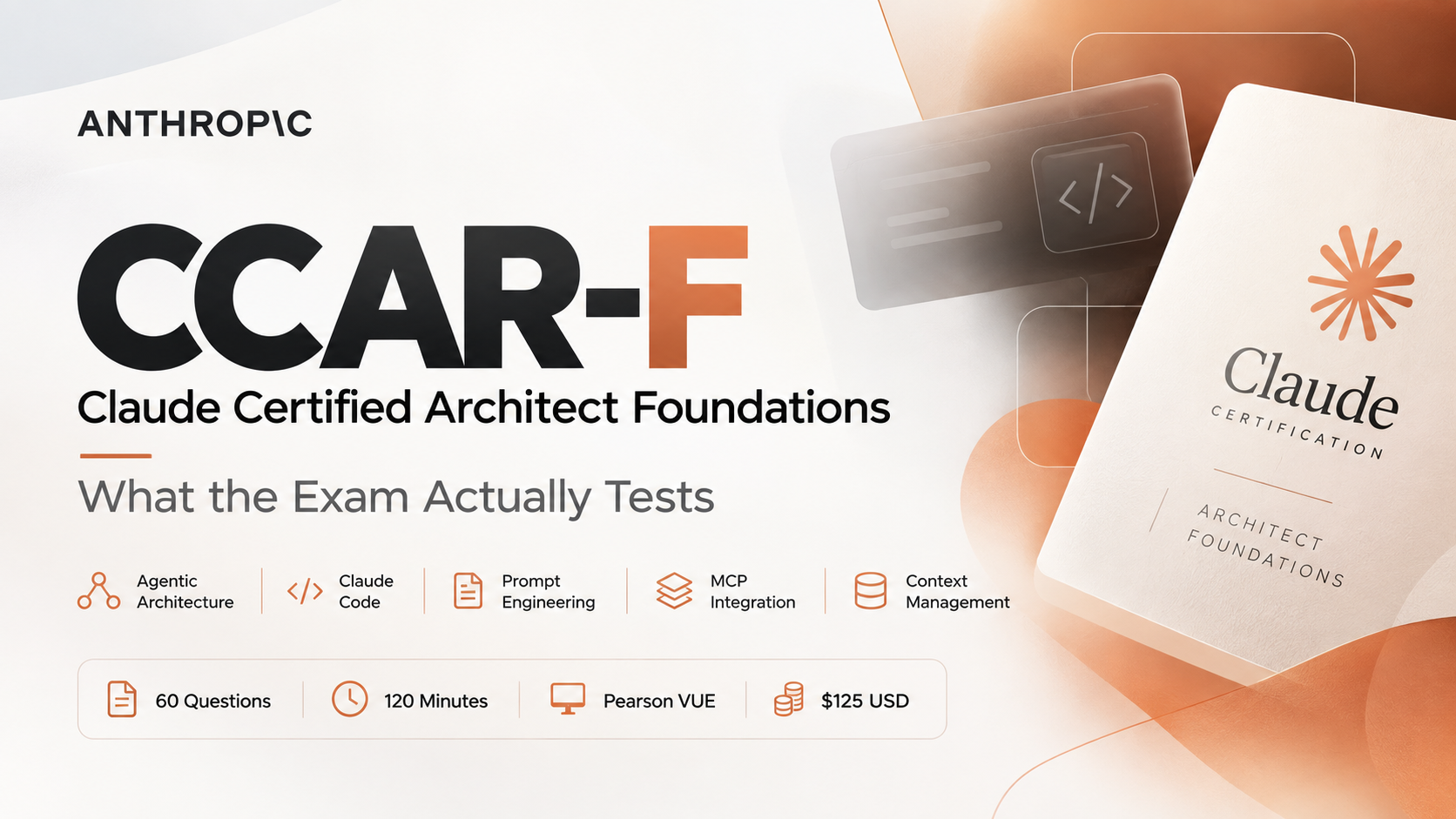
CCAR-F: The Claude Certified Architect Foundations Exam That Separates Claude Users From Claude Architects
Most engineers who work with Claude can get it to do something useful. Fewer can design a system where Claude does something useful reliably, at scale, across production edge cases they did not anticipate when they built it.
That gap is exactly what the CCAR-F was designed to measure.
The Claude Certified Architect Foundations certification is Anthropic's foundational credential for solution architects and senior engineers who design production Claude systems. Not people who use Claude. Not people who call the API and get answers back. People who make architectural decisions: which pattern to choose for a multi-agent workflow, how to scope tool permissions so an agentic system does not do more than it should, how to structure context so retrieval stays accurate under real query conditions.
The ccar-f exam launched in March 2026 and moved to Pearson VUE delivery on June 30, 2026. It is a 60-question, 120-minute proctored exam with a passing score of 720 on a scaled 100 to 1000 range. It costs $125 USD per attempt, with a 50 percent partner discount available for eligible Claude Partner Network members, bringing the fee to $62.50 for qualifying organizations.
Before getting into the domain breakdown and preparation strategy, one clarification that comes up constantly in study communities: if you are building Claude-powered products but primarily need the Associate-level overview of how Claude works as a platform, the CCAO-F is the more appropriate starting point. CCAR-F assumes you are already working with the Claude API, Claude Code, or the Agent SDK in a production or near-production context. The exam tests architectural judgment, not foundational familiarity.
Where CCAR-F Sits in the Claude Certification Program
Anthropic currently offers four proctored credentials:
The CCAO-F at $99 is for business professionals who use Claude in operational workflows, marketing, project management, and knowledge work. No coding required. The CCDV-F at $125 is for engineers building integrations and applications using the Claude API and Agent SDK. The CCAR-F at $125 is for solution architects who design production Claude systems across the full technical stack. The CCAR-P at $175 is for senior architects who own enterprise-scale Claude programs end to end.
CCAR-F sits at the intersection of technical depth and architectural scope. It is more technically demanding than CCAO-F but more focused on design decisions than CCAR-P, which tests delivery, governance, and stakeholder management at an enterprise level. If you design systems rather than just build components, CCAR-F is the appropriate credential to pursue before CCAR-P.
The Five CCAR-F Domains — What the Exam Actually Tests
The ccar-f exam is built around five official domains from Anthropic's Exam Guide v1.0, effective July 2026. The weightings are not intuitive, and treating all five domains equally in your preparation will cost you points in the areas where the exam actually concentrates.
Agentic Architecture and Orchestration — 27 Percent
The largest domain by a significant margin. This covers designing multi-agent systems from scratch: task decomposition, hub-and-spoke orchestration models, agentic loops, subagent coordination, escalation and handoff design, and reliability patterns for autonomous systems operating across multiple steps without continuous human oversight.
The core competency this domain tests is the decision of when to introduce agent autonomy and when to keep a human in the loop. Every question in this domain presents a production scenario and asks you to evaluate an architectural choice. An agent with too many tools and too much autonomy creates unpredictable behavior under edge conditions. An agent that escalates too frequently defeats the purpose of automation. The exam tests whether you can find the right boundary given a specific scenario's requirements and risk tolerance.
Candidates who underestimate this domain lose a quarter of their total score. It is the single most important domain to get right, and it is also the one where surface-level familiarity with agentic concepts is most likely to produce confident-but-wrong answers. Work through real multi-agent design problems before exam day, not just documentation.
Claude Code Configuration and Workflows — 20 Percent
CLAUDE.md file hierarchy, Agent Skills, custom slash commands, Plan Mode versus direct execution, headless mode for CI/CD integration, hooks, and persistent project context management. This domain tests whether you can configure Claude Code environments for team use and integrate Claude Code into real development workflows.
The scenario format this domain uses most often: a team wants to use Claude Code consistently across different developers with different local setups. What configuration approach ensures consistent behavior? Or: a CI/CD pipeline needs Claude Code to run without interactive prompts. What flag and configuration changes make that possible? These are applied questions requiring specific knowledge of how Claude Code's configuration hierarchy actually works.
Prompt Engineering and Structured Output — 20 Percent
Tied with Claude Code as the second-heaviest domain at 20 percent. This covers zero-shot, few-shot, and chain-of-thought prompting in production contexts, structured output design using XML tags and JSON schemas, system prompt design for consistency and reliability, prompt caching for performance and cost optimization, and iterative prompt improvement based on failure analysis.
The exam does not test basic prompting technique. It tests architectural-level prompt decisions. When should you use few-shot examples versus a longer system prompt? When does placing required parameters in a JSON schema structurally eliminate a class of hallucination? When does prompt caching make financial sense given the cost and usage patterns of a system? These are decisions that matter at scale, and the exam is calibrated to test them in that context.
Tool Design and MCP Integration — 18 Percent
Defining tool boundaries to match Claude's cognitive model, designing clear and unambiguous tool interfaces, implementing Model Context Protocol servers, error handling and failure response patterns for tool calls, and access control design for tool permissions.
The key principle this domain tests: tools with overlapping capabilities create ambiguity for the model. An agent that cannot clearly determine which tool to call in a given situation will make poor choices under real query conditions. The correct architectural response is to give Claude distinct, understandable capabilities with clear boundaries, not to provide everything and let the model sort it out.
Context Management and Reliability — 15 Percent
Context window management, retrieval-augmented generation pipeline design, chunking and indexing strategies matched to data shape and query patterns, escalation and confidence thresholds, graceful degradation when context limits are approached, and observability for production systems.
The RAG design questions in this domain follow a consistent pattern. A system starts returning confident-but-incorrect answers after a document corpus update. The exam expects you to investigate the retrieval and indexing pipeline first, not the prompt. A system is approaching context limits mid-conversation. The exam expects an architectural solution, such as progressive summarization or selective context retention, not simply truncating old content.
The Scenario Format — What Makes CCAR-F Different From Most Technical Exams
The ccar-f exam has a structural feature worth understanding before you book: the 60 questions are built around four production scenarios, drawn at random from a bank of six at the start of your session. Each scenario spans multiple domains. The six scenarios cover customer support agents, Claude Code in development workflows, multi-agent research pipelines, developer productivity tooling, CI/CD integration, and structured data extraction.
This means the exam is entirely applied. Every question is inside a realistic architectural context. You are never asked to define a concept in isolation. You are always being asked what an architect would do given a specific production situation with specific constraints.
For preparation, this matters because reading documentation and theory does not directly build the skill the exam tests. What builds it is working through realistic architectural scenarios, making decisions, and understanding why certain approaches fail under production conditions. The exam is specifically calibrated to distinguish between candidates who have read about agentic architecture and candidates who have designed agentic systems and dealt with their failure modes.
Who CCAR-F Is Actually For — And Who Should Take Something Else
The recommended profile Anthropic describes for CCAR-F candidates is solution architects, senior engineers, and technical consultants with six or more months of hands-on production experience building with Claude. Experience with the Agent SDK, Claude Code, and MCP in real systems is the relevant background, not familiarity with Claude as a chat interface.
No prior certification is required. CCAR-F does not mandate CCAO-F or CCDV-F as prerequisites. The exam credential is awarded on performance alone.
Candidates who are still building foundational API and integration skills should consider CCDV-F first. CCAR-F assumes those skills exist and tests whether you can make architectural decisions above them. Coming in without that foundation does not make CCAR-F impossible but it makes the scenario-based questions significantly harder to reason through.
Candidates targeting enterprise-level program ownership, including governance, compliance frameworks, executive communication, and multi-team orchestration, should be looking at CCAR-P rather than CCAR-F. The Professional credential builds directly on what Foundations validates, and most serious practitioners pursuing CCAR-P find CCAR-F a useful intermediate step.
Exam Format, Cost, and Registration Details
60 questions in 120 minutes, delivered through Pearson VUE either at a test centre or via online proctoring from home. Closed book and closed AI, which means no documentation, no notes, and no AI assistance during the session. Passing score is 720 on a scaled 100 to 1000 range.
The exam fee is $125 USD per attempt at the current list price. Eligible Select, Preferred, and Global Premier partners in the Claude Partner Network receive a 50 percent discount on their first attempt, bringing the fee to $62.50. The credential is valid for 12 months from the award date. On-time renewal is free through a non-proctored assessment on the Anthropic Partner Academy. A lapsed credential requires the full exam and fee to reinstate.
Registration is through the Anthropic Partner Academy platform. Access requires a company email tied to a Claude Partner Network member organization. The Claude Partner Network is free to join, which addresses the access concern directly for independent engineers and consultants at smaller organizations. After completing access prerequisites on the platform, you schedule your Pearson VUE session to choose your date and delivery format.
Retake waiting periods follow the same structure as other Claude credentials: 14 days after a first failure, 30 days after a second, 90 days after a third. Maximum four attempts within a rolling 12-month period. Each retake carries the full exam fee.
How to Prepare for CCAR-F — A Realistic Starting Point
A four-week preparation path works for most candidates with the recommended production background. The first week is for reading the official exam guide, rating yourself honestly across all five domains, and beginning to build or revisit one real end-to-end agentic system that you will continue working with through the preparation period. Anthropic's official guide recommends hands-on work specifically because the scenario-based exam format cannot be adequately prepared for through reading alone.
Week two focuses on the two heaviest domains: Agentic Architecture and Orchestration at 27 percent and whichever of Claude Code Configuration or Prompt Engineering represents your larger knowledge gap. Design a multi-agent workflow with explicit handoff rules, confidence thresholds, and escalation paths. Work through the failure modes of that design before studying the next domain.
Week three covers Tool Design and MCP Integration and Context Management and Reliability. Build and test a tool with deliberately narrow scope and explicit error responses. Design a RAG pipeline for a document corpus with realistic size and update frequency, then trace through what breaks when the corpus is updated incorrectly.
Week four is entirely ccar-f practice questions and scenario-based exercises. The readiness signal is the same as for any scenario-based technical exam: scoring consistently above 80 percent on realistic practice sets across all five domains before booking your exam date.
For verified ccar-f practice questions aligned to the current v1.0 exam blueprint, CertsInfinity offers practice materials for the Architect Foundations credential. Given that the exam launched in March 2026 and the Pearson VUE delivery only went live in June, many resources predating those milestones do not accurately reflect the current format or domain weightings. Verifying that any practice material reflects Anthropic's v1.0 exam guide effective July 2026 is worth doing before committing preparation time to it.
Frequently Asked Questions
What is the CCAR-F exam?
CCAR-F is Claude Certified Architect Foundations, Anthropic's foundational certification for solution architects and engineers who design production systems using Claude. It is 60 questions in 120 minutes, closed book, delivered through Pearson VUE, and requires a scaled score of 720 to pass.
How much does the CCAR-F exam cost?
The list price is $125 USD per attempt. Eligible Claude Partner Network members at Select, Preferred, and Global Premier tier receive a 50 percent discount on their first attempt, bringing the fee to $62.50.
What are the five CCAR-F domains?
Agentic Architecture and Orchestration at 27 percent, Claude Code Configuration and Workflows at 20 percent, Prompt Engineering and Structured Output at 20 percent, Tool Design and MCP Integration at 18 percent, and Context Management and Reliability at 15 percent.
Is CCAR-F open book?
No. The exam is closed book and prohibits notes, documentation, and AI assistance. The scenario-based format means notes would not provide much practical help anyway, since the questions test judgment under realistic conditions rather than recall of definitions.
How does CCAR-F differ from CCAR-P?
CCAR-F validates the ability to design production Claude systems at a foundational architectural level. CCAR-P validates the ability to own enterprise Claude programs end to end, including governance, compliance, stakeholder management, and multi-team orchestration. CCAR-F is the appropriate starting point for most practitioners before pursuing Professional.
Do I need CCAO-F before taking CCAR-F?
No. CCAR-F has no mandatory prerequisites. The credential is awarded on exam performance. The recommended background is six or more months of hands-on production experience with Claude, not a prior certification.
How long is the CCAR-F credential valid?
12 months from the award date. On-time renewal is free through a non-proctored assessment on the Anthropic Partner Academy. A lapsed credential requires the full exam and fee to reinstate.
What jobs open up after CCAR-F?
The roles most directly aligned include AI Solution Architect, Multi-Agent System Engineer, Developer Enablement Engineer, and Technical Consultant specializing in Claude-based systems. For detailed career expectations, the CCAR-F worth it article in this cluster covers that ground specifically.
One Thing to Do Before You Register
Read the official CCAR-F exam guide from Anthropic before you book. It is available through the Anthropic Partner Academy and contains the authoritative domain weights, task statements, and scenario descriptions that every other resource derives from. The guide is specific about what the exam tests and, by implication, what it does not. Reading it first saves preparation time by narrowing your focus to what actually matters on exam day.
The exam is 120 minutes. The certification lasts 12 months. The architectural judgment it validates is what separates system designers from system users.
For CertsInfinity's CCAR-F practice question catalog and current pricing: certsinfinity.com