
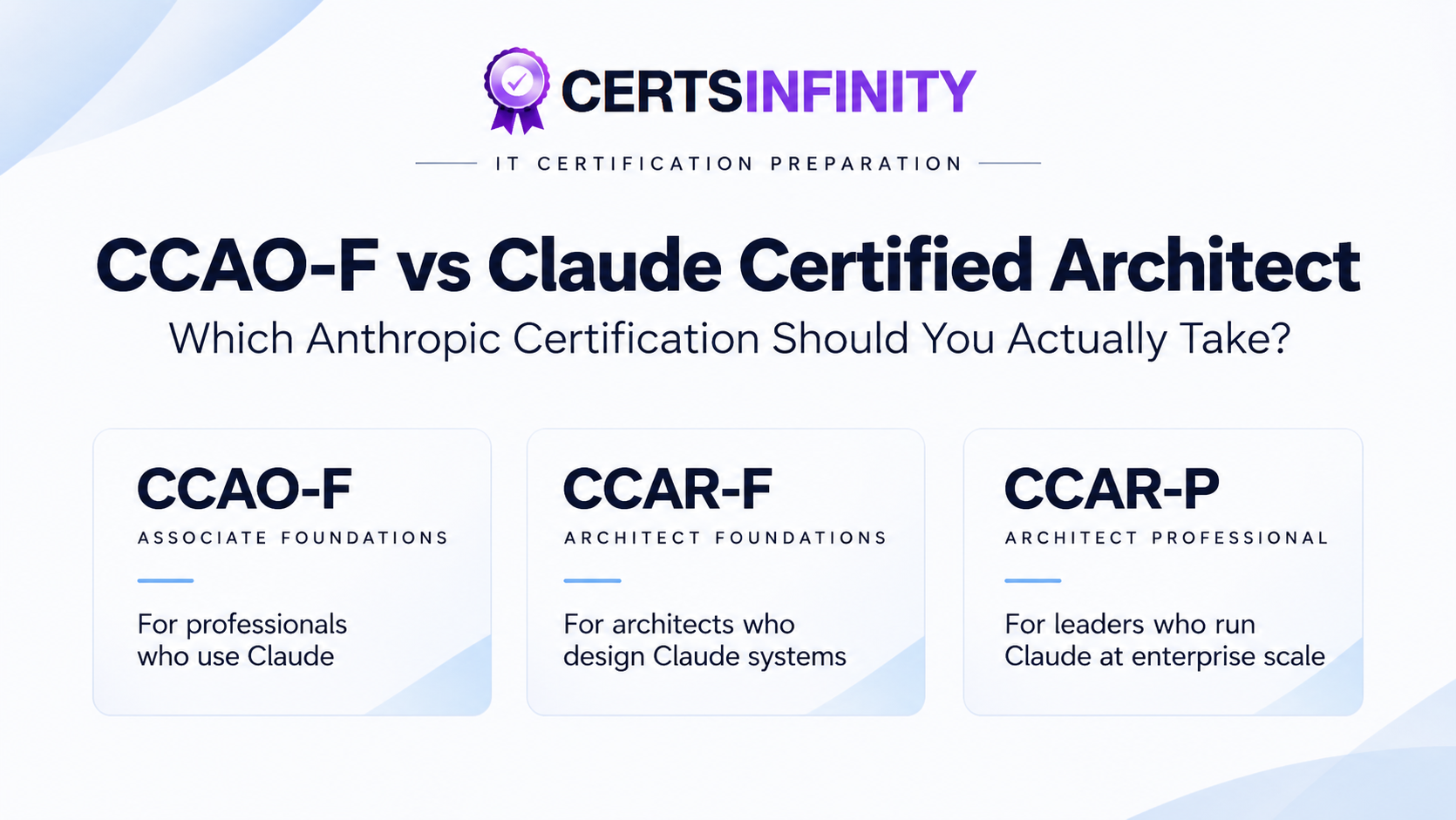
CCAO-F vs Claude Certified Architect: Which Anthropic Certification Should You Actually Take?
Certs Infinity publishes independent certification study guidance to support this article.
There are four Claude certifications. Most people researching them know the names. Very few know which one is actually theirs.
That confusion is understandable. All four credentials sit inside the same certification program, they all require a passing score of 720, and they are all delivered through Pearson VUE. From the outside, the differences look like a matter of level — beginner, intermediate, advanced. Take the lowest one first, then work your way up.
That framing is wrong, and it leads people to spend time and money preparing for an exam that does not match what they actually do. The Claude certification program in 2026 is best understood as a map of roles rather than a ladder of difficulty. The right exam is the one that describes your work, not the one that sits at the bottom of a list.
This article is for anyone who has looked at CCAO-F, CCAR-F, and CCAR-P and is not sure which one belongs to them.
Why the Decision Is Harder Than It Looks
The exam names do not help. Claude Certified Associate Foundations and Claude Certified Architect Foundations both sound like starting points. One says Associate. One says Architect. Neither name tells you clearly whether you need coding experience, what kind of work each credential covers, or whether you should take one before the other.
Anthropic publishes no prerequisites for any exam, and no certification requires holding another one first. That is liberating in one sense — you can register for CCAR-P without holding CCAO-F. It is confusing in another, because the absence of a forced sequence means you have to figure out the right starting point yourself.
The clearest way to find that starting point is to look at what each exam actually tests, and match that to what you actually do at work.
CCAO-F: The Credential for People Who Use Claude
The Claude Certified Associate Foundations is designed for practitioners using Claude for daily productivity improvements and project management. The target audience is non-developers in operations, marketing, project management, public relations, and similar roles.
The exam has seven domains. The largest one at 21 percent is Output Evaluation and Validation, which tests whether you can assess what Claude produces before you act on it, share it, or build on it. The second largest at 16 percent is Workflow Integration and Solution Design. Governance, Risk, and Responsible Use sits at 15 percent. The remaining four domains cover prompting, model selection, project configuration, and troubleshooting.
No coding. No API calls. No architecture diagrams. The entire exam is built around professional judgment in business contexts.
CCAO-F costs $99 and is the one Claude certification that does not count toward a firm's Claude Partner Network tier. It currently has 60 questions in 120 minutes, with a December 7, 2026 update scheduled to increase the question count to 70.
The person CCAO-F is built for uses Claude inside claude.ai every day. They write prompts, review outputs, manage Projects with custom instructions, and think about whether Claude's answers are accurate enough to share. They are not building the systems that other people use. They are using the systems that other people built.
CCAR-F: The Credential for People Who Design Claude Systems
CCAR-F is for architects and senior developers designing agentic systems. The right exam for someone who designs how agents, tools, and context fit together.
The exam has five domains with a noticeably different emphasis. Agentic Architecture and Orchestration carries 27 percent, the largest share by a significant margin. Claude Code Configuration and Workflows sits at 20 percent. Prompt Engineering and Structured Output is also 20 percent. Tool Design and MCP Integration carries 18 percent. Context Management and Reliability rounds out at 15 percent.
The subject matter tells you exactly who this exam is for. Multi-agent system design, Model Context Protocol implementation, RAG pipeline architecture, tool permission scoping, context window management under production conditions. These are not topics that come up in a marketing meeting.
CCAR-F costs $125 and targets architects with roughly six months of production Claude experience. The exam is scenario-based throughout, which means every question presents a real architectural decision with multiple plausible options. The right answer almost always depends on understanding tradeoffs rather than recalling a feature name.
CCAR-P: The Credential for People Who Lead Claude at Enterprise Scale
CCAR-P is suited for lead engineers overseeing enterprise-wide system integration, security, legal governance, and lifecycle management.
CCAR-P costs $175 and is the credential for someone who already leads Claude architecture at scale. It has seven domains covering integration, solution design and architecture, evaluation and testing, governance and safety, stakeholder communication and lifecycle management, models and prompting, and developer productivity. The governance and stakeholder domains together account for 27 percent of the exam, which reflects what separates Professional-level work from Foundations-level work. At the Professional tier, the work is not just designing systems. It is governing them, explaining them to legal and compliance teams, managing their lifecycle, and owning the organizational consequences when something goes wrong.
Foundations is Anthropic's recommended progression toward Professional, but the July 2026 CCAR-P guide states no mandatory prerequisite credential or course. Experienced architects can go straight to CCAR-P, since no prerequisites exist, though most candidates benefit from the Foundations vocabulary first.
The Decision Framework: One Question That Settles It
Before looking at exam codes and fees, ask yourself one question.
What does your work actually involve?
If your answer is using Claude to get things done — writing, research, analysis, project coordination, knowledge work — CCAO-F is your exam. The credential validates that you can use Claude well and responsibly in professional contexts. That is a genuinely useful thing to prove, and it matches what you do.
If your answer is designing the systems that other people use Claude through — building agents, configuring MCP servers, architecting RAG pipelines, writing Claude Code workflows — CCAR-F is your exam. The technical depth of that exam reflects the technical depth of that work.
If your answer is leading an organization's Claude deployment — owning the architecture decisions, managing governance and compliance, communicating with executives and legal teams about AI risk — CCAR-P is where you belong, with or without CCAO-F behind you.
The simplest version of this framework: you use Claude to get work done, take CCAO-F. You design how agents, tools, and context fit together, take CCAR-F. You already lead Claude architecture at scale, take CCAR-P.
The Most Common Confusion: Should You Take CCAO-F Before CCAR-F?
This question comes up constantly, and the answer depends on your background.
For the AI solution architect track, CCAO-F is optional before CCAR-F. For architects, consultants, and technical leaders, the recommended path is CCAR-F followed by CCAR-P, with CCAO-F serving as optional preparation rather than a mandatory step.
If you already design production systems and your day involves architecture decisions rather than business productivity work, CCAO-F covers material that is below your current level. Taking it first adds time and cost without meaningfully accelerating your CCAR-F preparation.
If you are transitioning from business user to architect, or if you want to build foundational vocabulary before approaching CCAR-F's technical depth, CCAO-F is a reasonable first step. Most candidates benefit from the Foundations vocabulary first even when no prerequisite is enforced.
The honest version: CCAO-F and CCAR-F are not sequential credentials for the same person. They are parallel credentials for different roles. Most people who need CCAR-F do not need CCAO-F first. Most people who need CCAO-F do not need CCAR-F at all.
What Changes on December 7, 2026
Content updates are scheduled for December 7, 2026 across the Claude certification program. For CCAO-F specifically, the question count increases from 60 to 70. If you are preparing for CCAO-F and plan to sit before that date, your current study material is accurate. If you are planning to sit after December 7, confirm that your practice materials have been updated to reflect the expanded question set.
This kind of update is exactly why the 90-day free update window on CertsInfinity practice materials matters. If you buy practice questions before the December update and sit after it, your material will reflect the current blueprint at the time of your exam.
Practical Summary: Which Exam Is Actually Yours
The easiest way to settle this is to match your day-to-day work to the credential that describes it.
You write prompts, review Claude outputs, manage Projects inside claude.ai, and think about whether AI-generated content is accurate enough to share or act on. That is CCAO-F. The exam validates professional judgment in using Claude, not technical expertise in building with it.
You write system prompts, configure MCP servers, design multi-agent workflows, build RAG pipelines, and make decisions about tool permissions and context management in production systems. That is CCAR-F. The exam validates solution architecture expertise with Claude's technical stack.
You lead the organizational deployment of Claude, own governance and compliance decisions, manage stakeholder communication at the executive level, and are accountable for how Claude performs across teams and systems. That is CCAR-P. The exam validates enterprise leadership of Claude programs at a level that includes legal, security, and business continuity.
For verified practice questions aligned to whichever credential fits your situation, CertsInfinity covers all three: certsinfinity.com
Frequently Asked Questions
Is CCAO-F required before CCAR-F?
No. Foundations is Anthropic's recommended progression, but the July 2026 CCAR-P guide states there is no mandatory prerequisite credential or course. If your work is architecture rather than business productivity, you can go directly to CCAR-F.
Can I take CCAR-P without CCAR-F?
Yes. Anthropic publishes no prerequisites for any exam. Experienced architects can go straight to CCAR-P, though most candidates benefit from the Foundations vocabulary first.
How much does each Claude certification cost?
CCAO-F costs $99, CCAR-F costs $125, and CCAR-P costs $175. All three are delivered through Pearson VUE, online or at a test center.
What is the passing score for all Claude certifications?
720 on a scaled range of 100 to 1,000. The same threshold applies to CCAO-F, CCAR-F, and CCAR-P.
How long are the exams?
All three exams give you 120 minutes. CCAO-F currently has 60 questions, increasing to 70 on December 7, 2026. CCAR-F has 60 questions. CCAR-P has 63 questions.
Which Claude certification is best for someone with no technical background?
CCAO-F is the right choice for practitioners using Claude for daily productivity improvements without development experience, covering roles in operations, marketing, project management, and similar functions.
How long does the credential last?
All Claude certifications are valid for 12 months from the award date. On-time renewal is free through a non-proctored assessment on the Anthropic Partner Academy. A lapsed credential requires the full exam and fee to reinstate.
What is the difference between Claude Certified Associate and Claude Certified Architect?
CCAO-F covers Claude fundamentals, AI concepts, responsible AI usage, and basic prompting for business users. CCAR-F and CCAR-P develop AI architecture expertise, covering agent system design, MCP integration, enterprise governance, and solution architecture at increasing levels of depth.